ACSM · Source check: 27 October 2026
ACSM Preparticipation Screening: Read the Decision Before the Workout
Learn the ACSM screening inputs, symptom and disease branches, medical clearance decisions, and common errors with worked client cases.
ACSM-CPT scope: Resources for the Personal Trainer, 6th edition; Guidelines for Exercise Testing and Prescription, 12th edition (exam alignment effective July 10, 2025). Public sources below are identified separately by date; this guide does not reproduce the textbook.
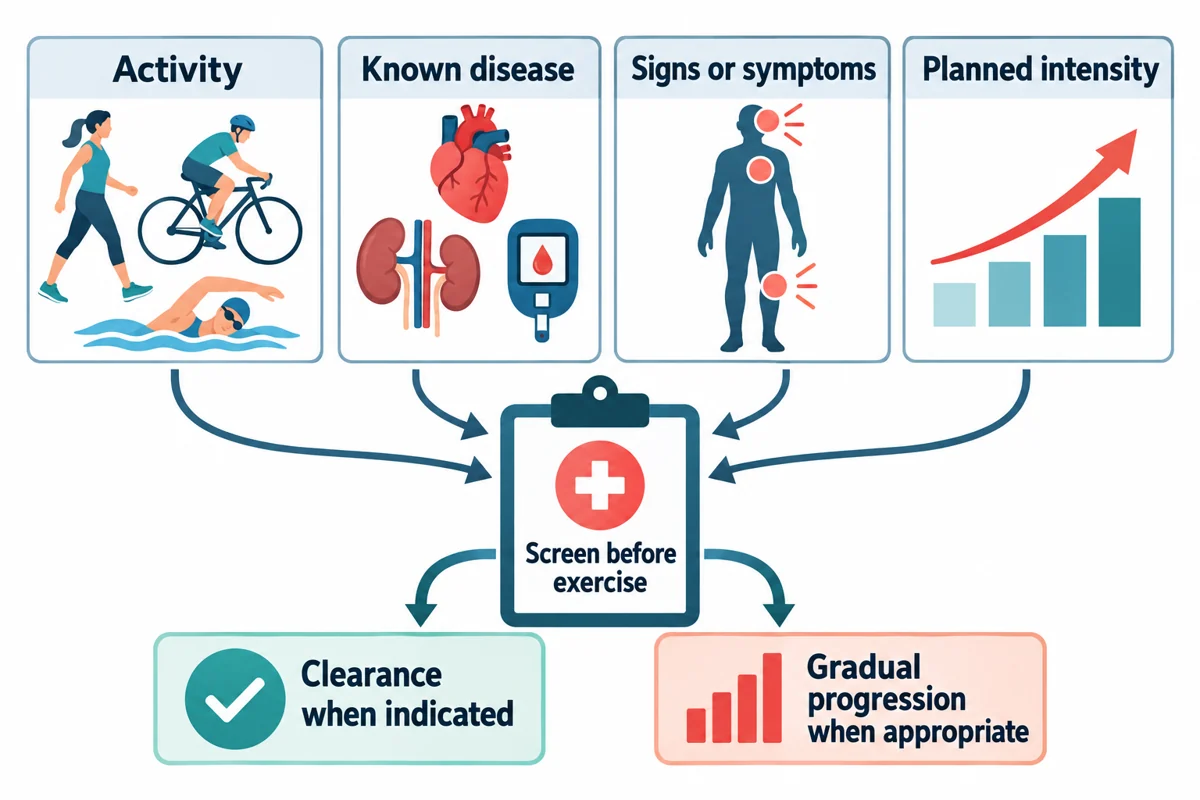
The screening decision comes before the fitness score
A client can look fit, own running shoes, and still need a different entry decision from another client with the same goal. ACSM preparticipation screening asks whether the person can begin or continue exercise, whether medical clearance is recommended, and how the intended intensity affects that decision. It is not a test of how many push-ups someone can perform. The result guides the next step before a trainer selects an exercise assessment.
For study purposes, keep a short case record with four fields: current exercise participation, known disease, relevant signs or symptoms, and intended intensity. Place each detail in its field before choosing an answer. A history statement such as “used to run” belongs in the activity field, but it does not establish current regular exercise. A desire to run a race belongs in the intensity and goal discussion, not in the evidence of present fitness.
Establish what regular exercise means
The ACSM algorithm defines regular participation using planned, structured exercise of at least moderate intensity for at least 30 minutes on at least three days each week, maintained for at least three months. Ask about all parts of that definition. An occasional long weekend hike does not establish the required weekly pattern. Neither does a gym membership that the client has not used recently.
Consider a fictional intake: Morgan walks briskly for 35 minutes on Monday, Wednesday, and Friday and has done so for four months. That history fits the operational activity definition if the effort is at least moderate. Now change only the history: Morgan stopped six months ago. The old habit is useful background, but the screening path must use the present inactive status. In a case question, mark the time window explicitly instead of letting the word “runner” decide the branch.
Separate known disease from risk factors
The screening framework considers known cardiovascular, metabolic, or renal disease. Cardiovascular disease includes cardiac, peripheral vascular, and cerebrovascular disease; diabetes is a relevant metabolic disease. The 2015 update removed cardiovascular risk-factor counting and low, moderate, or high risk classification from this particular referral algorithm. That change does not make smoking, blood pressure, or family history irrelevant to the broader consultation.
A useful distinction is between information that changes an algorithm branch and information that shapes later programming. Suppose two inactive, asymptomatic adults want to start walking. One reports several risk factors without known disease; the other reports diagnosed diabetes. Those descriptions are not interchangeable. Do not quietly substitute “several risk factors” for “known disease,” and do not assume a normal-looking client has no diagnosed condition. Record the actual history and clarify missing information before applying the branch.
Recognize symptoms that change the next action
Relevant warning symptoms include chest or related discomfort that may reflect ischemia, unusual breathlessness, dizziness or fainting, and other signs identified in the screening guidance. An active person who develops such signs or symptoms should stop exercise and seek medical clearance before resuming. The trainer's task is to recognize the need for evaluation, rather than identify the medical cause from a brief intake conversation.
For example, Taylor reports recent fainting during an uphill walk. The first decision is not whether a cycle test would be easier than a treadmill test. The unexplained exertional symptom changes the entry decision. In another case, the client reports only ordinary effort during a familiar workout; that wording is different from unexplained symptoms at rest or mild exertion. Read the full description and avoid converting every mention of breathing or tiredness into a diagnosis.
Apply clearance and intensity together
An inactive, asymptomatic person without known relevant disease can begin light-to-moderate activity and progress gradually. An inactive person with known cardiovascular, metabolic, or renal disease is directed toward medical clearance before starting. For a regularly active, asymptomatic person with known disease, the guidance distinguishes continuing moderate exercise from advancing to vigorous exercise. Use the complete official algorithm when deciding the specific branch.
Medical clearance means approval from an appropriate health care professional to exercise. It does not automatically mean that every referred client must complete a maximal exercise stress test. A trainer should pass along the intended activity and relevant observations, then follow the clinician's findings and restrictions. In a written case, an option that invents mandatory testing can be wrong even when referral itself is appropriate. Clearance, diagnostic testing, and exercise prescription are related decisions with different purposes.
Turn a branch into a usable handoff
After screening, document the information used, the branch selected, any referral, and the agreed next step. A practical handoff identifies the activity the client wants to perform and the questions that require clinical guidance. If a restriction returns, build the assessment and program around that restriction. A completed form does not remove the need to respond when the client's health or symptoms change.
Work through cases by changing one variable at a time. Keep the same walking goal but change inactive to regularly active. Keep activity constant but add a new symptom. Keep symptoms absent but change the proposed session from moderate to vigorous. Explain why each alteration does or does not change the action. This approach makes the algorithm a sequence of decisions you can defend, rather than a picture you can recognize only when every example uses familiar words.
Put the concept into practice
Answer an original 30-question set for your chosen certification, then review your domain report.
Try 30 free questionsUSD 9.99 · Access detailsSee the current purchase availability and access terms on the product page.
Questions about this topic
Does ACSM screening still count risk factors to decide clearance?
The 2015 screening update removed risk-factor counting from this referral algorithm. Current activity, known disease, signs or symptoms, and intended intensity guide the decision.
Does a referral always require a maximal exercise test?
No. Medical clearance and exercise testing are separate decisions; the clearing health care professional decides what evaluation is needed.
Can a former runner automatically use the active branch?
No. Establish whether the current history meets the regular-exercise definition, including frequency, duration, intensity and the recent three-month pattern.
Official sources
Checked 27 October 2026
- ACSM Certified Personal Trainer preparation and GETP 12 alignment · 2026-10-27
- Updating ACSM’s Recommendations for Exercise Preparticipation Health Screening · 2026-10-27
- ACSM-CPT Exam Content Outline, effective July 10, 2025 · 2026-10-27
- Applying the ACSM Preparticipation Screening Algorithm to U.S. adults · 2026-10-27
- New Preparticipation Health Screening Recommendations: What Exercise Professionals Need to Know · 2026-10-27
- ACSM Health/Fitness Facility Standards and Guidelines, fifth edition · 2026-10-27