ACSM · Source check: 27 October 2026
ACSM Fitness Testing Order: Protect the Baseline and the Comparison
Plan an ACSM-style assessment session around screening, resting measures, fatigue control, consistent procedures and useful interpretation.
ACSM-CPT scope: Resources for the Personal Trainer, 6th edition; Guidelines for Exercise Testing and Prescription, 12th edition (exam alignment effective July 10, 2025). Public sources below are identified separately by date; this guide does not reproduce the textbook.
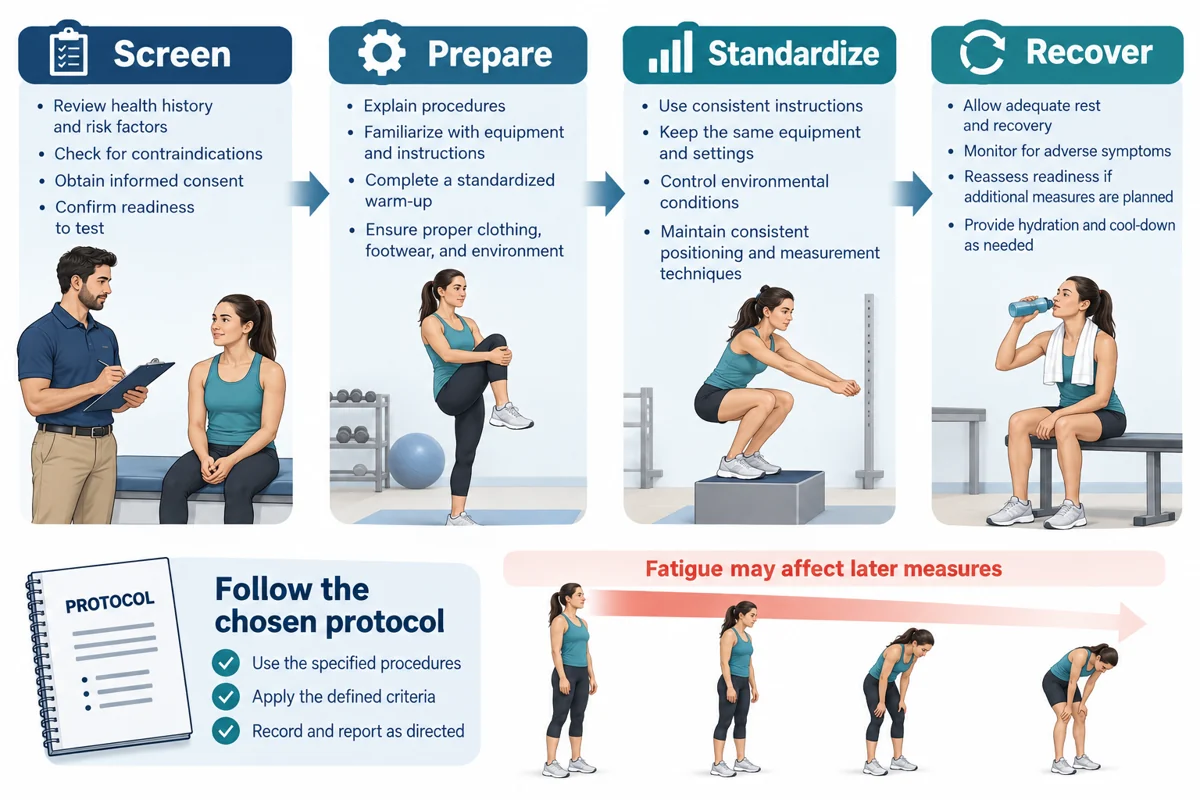
Testing order serves the assessment
A useful assessment tells the trainer something about the client that can guide a program. Order matters because one task can change the conditions under which the next task is measured. The ACSM-CPT content outline includes preparation, testing protocols, interpretation, and the recommended order of fitness assessments. These are connected skills: remembering a list does not compensate for taking a resting measure after hard exercise.
Start with the question the assessment must answer. A new client's need for a safe entry decision differs from a returning client's need to compare strength with an earlier record. Write down the tests, why each is needed, and what could interfere with each result. That plan makes the sequence explainable. It also helps identify tasks that should be omitted, modified, or scheduled elsewhere because the client or facility cannot support a meaningful result that day.
Screen and explain before exertion
Health screening and informed consent belong before an exercise assessment. ACSM facility guidance includes preparticipation screening, orientation, supervision, emergency procedures, and evaluation forms. Those processes establish whether the planned testing is appropriate and help the client understand what will happen. A signed form is not a substitute for explaining the assessment or noticing new information at the visit.
For an illustrative intake, suppose the client arrives with a completed questionnaire but describes recent unexplained fainting when the trainer asks about changes. The session should not proceed simply because the first station is ready. In another example, a client is unsure how a test works. Explain the purpose, procedure, and ability to stop before collecting a score. These actions are part of test preparation; postponing them until after a fatiguing task turns the session timetable into the decision maker.
Keep resting measurements genuinely at rest
Resting blood pressure requires standardized conditions. The AHA measurement statement specifies quiet seated rest, an appropriate cuff, supported positioning, feet on the floor, and an arm supported near heart level. These details illustrate why an assessment session needs a quiet preparation period. The reading should represent the intended resting condition rather than a rushed transition from walking, talking, or an exercise station.
Consider a trainer who measures pulse and blood pressure immediately after a step test and labels them “baseline.” The error is in the condition being measured. Recording the number more carefully cannot restore the missed resting condition. A better session plan protects the quiet measurement period before exertion and records how the measurement was obtained. If a client arrives hurried or a reading is unexpected, clarify the circumstances and follow the measurement and referral procedures rather than treating the first number as definitive.
Avoid inventing a universal active-test sequence
Public ACSM materials identify fitness testing order as examinable, but the sources linked here do not establish a complete, fixed GETP 12 sequence for every combination of active tests. Use the edition-specific protocol for the actual battery. The defensible general planning questions are whether earlier work changes the next test, whether the client has recovered sufficiently, and whether the chosen sequence can be repeated.
For example, if an assessment is intended to describe fresh lower-body performance, placing it immediately after a demanding leg-endurance task creates a different condition. If both tasks are necessary, plan adequate recovery or separate them according to the protocols. This is a reasoning example, not an official ACSM ranking of all tests. Do not import a sports-performance battery from another certification and call it the required ACSM sequence. First identify the purpose and protocol, then decide how the session should be organized.
Standardization includes more than order
A repeat assessment needs a record of the method and the conditions, not just the result. The ACSM content outline includes test preparation, administration, scoring and interpretation. A change in warm-up, apparatus, body position, instructions, or endpoint may change what the result means. The relevant test protocol determines which details must be held constant and which deviations must be documented.
Suppose a client performs a flexibility test without a warm-up at baseline but after a warm-up at follow-up. Even if the follow-up score is larger, the trainer cannot attribute the full difference to the training program. Or imagine a repetition test that accepts a shorter range of motion at follow-up. Counting more repetitions does not automatically demonstrate improved performance on the original task. In both cases, explain the changed conditions and avoid a stronger conclusion than the records can support.
Use the result to make a bounded decision
A test score is one part of a consultation. Choose measures that are appropriate to the client's condition and relevant to the intended program, explain their limits, and connect the findings to a next step. ACSM's role definition includes developing fitness programs for healthy individuals and people with medical clearance. It does not turn an exercise assessment into a medical diagnosis.
A practical session record can contain the screening decision, test names and versions, sequence, preparation, results with units, symptoms, deviations, and the action taken. When reviewing a case question, ask what was actually measured, whether the stated conditions were met, and whether the comparison uses the same task. If the answer depends on a precise order or recovery interval, return to that test's official protocol. Good testing is an organized measurement process, with the client's safety and the meaning of the score guiding each transition.
Put the concept into practice
Answer an original 30-question set for your chosen certification, then review your domain report.
Try 30 free questionsUSD 9.99 · Access detailsSee the current purchase availability and access terms on the product page.
Questions about this topic
Should resting blood pressure be measured after a step test?
No. A resting reading requires the specified quiet resting preparation; a post-exercise reading describes a different condition.
Is there one fixed sequence for every ACSM assessment?
The public sources cited here do not establish one universal GETP 12 sequence. Follow the edition-specific protocol and protect each test from interference.
Can a higher retest score prove improvement if the protocol changed?
A changed protocol limits the comparison. Record and explain the change before attributing the difference to training.
Official sources
Checked 27 October 2026
- ACSM Certified Personal Trainer preparation and GETP 12 alignment · 2026-10-27
- ACSM-CPT Exam Content Outline, effective July 10, 2025 · 2026-10-27
- ACSM Health/Fitness Facility Standards and Guidelines, fifth edition · 2026-10-27
- Measurement of Blood Pressure in Humans: AHA Scientific Statement · 2026-10-27