ACSM · Source check: 27 October 2026
ACSM Special Populations: Adapt the Plan to the Person
Study how health conditions, medications, symptoms and clinical restrictions change exercise planning across several ACSM client scenarios.
ACSM-CPT scope: Resources for the Personal Trainer, 6th edition; Guidelines for Exercise Testing and Prescription, 12th edition (exam alignment effective July 10, 2025). Public sources below are identified separately by date; this guide does not reproduce the textbook.
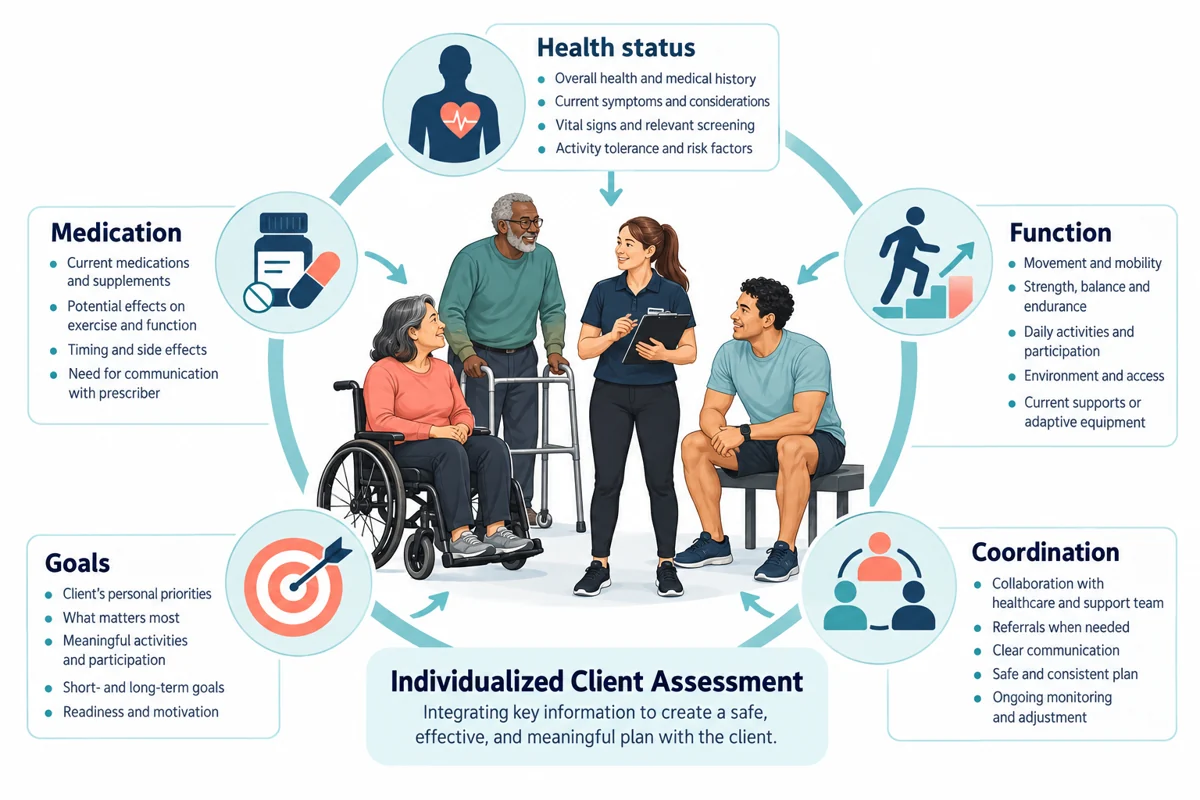
A category name is only the beginning
Special-population exercise planning begins with the individual's health information, functional ability, symptoms, medications, and goals. People sharing a diagnosis may need different exercise choices. ACSM-CPT practice includes working with healthy people and people who have medical clearance, while recognizing when the client's needs require referral or additional expertise. The useful exam skill is selecting the next appropriate action from the information given.
Do not turn a category into a single memorized workout. A client with a medically managed condition may have clear restrictions, while another person needs evaluation before starting. An older client may also have arthritis, diabetes, and a history of cancer treatment. Keep those facts visible instead of choosing whichever label appears first. An illustrative planning record might list what is permitted, what needs modification, what must be monitored, and what would trigger contact with the health care team.
Diabetes: understand the medication context
The ACSM type 2 diabetes consensus statement describes exercise as part of individualized care. Medication and complications matter when planning activity. Insulin and some insulin-releasing drugs can increase the risk of exercise-related hypoglycemia. Other concerns can involve feet, vision, autonomic responses, kidney disease, and cardiovascular disease. A diagnosis alone does not tell the trainer which of these applies to a particular client.
For example, a client using insulin wants to extend sessions substantially. A defensible next step is to coordinate the exercise and glucose-management plan with the established clinical guidance, rather than independently changing the medication dose. Ask what monitoring, supplies, symptom response, and follow-up have been agreed. A different client who is not taking glucose-lowering medication may have a different risk pattern. In a question, look for the medication and complication details before assuming all diabetes cases require the same session response.
Hypertension: the prescription includes monitoring
ACSM's hypertension guidance discusses aerobic, resistance, and flexibility exercise, gradual progression, and the influence of concomitant medication and other conditions. The goal is to select a tolerable, appropriate dose rather than use a high blood-pressure label as a reason for permanent inactivity. The trainer also needs to follow the client's clinical restrictions and use proper measurement procedures when monitoring blood pressure.
Imagine a cleared client who tolerates an established moderate session and asks to increase every part of the workout at once. Review the response and modify the dose gradually. If the client takes a drug that changes exercise responses, that information belongs in the monitoring plan. Keep the reasoning specific: which variable is changing, what response will be checked, and what guidance limits the change? A generic statement that exercise is beneficial does not answer those planning questions.
Arthritis: choose an activity the client can use
ACSM identifies exercise as part of arthritis management. That broad principle supports continued attention to movement, but it does not require a client to repeat an exercise that is currently painful or unsuitable. The practical choice should take account of symptoms, function, preferences, and any clinical advice. A trainer should avoid diagnosing the source of pain from a brief movement observation.
Consider a fictional client with managed knee osteoarthritis who finds jogging uncomfortable but can cycle comfortably within the approved plan. Switching to a suitable cycling option can preserve an aerobic training opportunity. The relevant change is not “give up exercise”; it is select a mode that the person can perform. If symptoms change or the planned activity cannot be made appropriate, refer for guidance. Write the reason for the modification so a later trainer does not interpret the substitute as an arbitrary preference.
Pregnancy: approval does not remove the need to adapt
ACSM provides a pregnancy activity resource; ACOG's clinical guidance supplies public detail on screening, modifying activity, hydration, avoiding excessive heat, and responding to warning symptoms. Uncomplicated pregnancy can include exercise, but the program should reflect the person's history and obstetric guidance. Warning signs such as bleeding, chest pain, dizziness, or fluid leakage require stopping activity and appropriate clinical follow-up.
For an example, a cleared pregnant client feels unwell while lying flat for an exercise. Stop that position and follow the established guidance rather than insisting that a previously approved workout must remain unchanged. Another client may need lower-impact or more stable options as balance and comfort change. In exam cases, medical approval and current symptom response are separate pieces of information. Approval permits an appropriate program; it does not authorize ignoring a new symptom or adding an unreviewed high-risk activity.
Cancer and overlapping conditions require a coordinated plan
ACSM's cancer exercise guidance encourages avoiding inactivity and recognizes aerobic and resistance training as useful components of care. The prescription can vary with the outcome being targeted and the person's treatment and functional status. More recent guidance for older cancer survivors adds attention to balance, functional assessment, supervision, symptoms, and the exercise environment. These recommendations describe a need for tailoring, not one workout for every survivor.
A useful study approach is to separate stable background information from a new change. Record the permitted activities and restrictions, then ask what today is different: fatigue, pain, dizziness, recent treatment, or reduced ability to manage the task. The trainer can modify within competence and coordinate with the clinical team. When several conditions overlap, choose a plan that respects all relevant limits. Solving only the easiest diagnosis in the case can leave the most consequential restriction unaddressed.
Put the concept into practice
Answer an original 30-question set for your chosen certification, then review your domain report.
Try 30 free questionsUSD 9.99 · Access detailsSee the current purchase availability and access terms on the product page.
Questions about this topic
Do all clients with the same condition use one exercise prescription?
No. Function, symptoms, medication, complications, goals and clinical restrictions require individualization.
Can a personal trainer change an insulin dose for a longer workout?
Medication adjustments belong with the prescribing clinical team. The trainer coordinates the exercise plan with the agreed glucose-management guidance.
Does medical clearance mean a new symptom can be ignored?
No. New symptoms or changed health status can require stopping, modifying the session or obtaining further clinical guidance.
Official sources
Checked 27 October 2026
- ACSM Certified Personal Trainer preparation and GETP 12 alignment · 2026-10-27
- ACSM-CPT Exam Content Outline, effective July 10, 2025 · 2026-10-27
- Exercise/Physical Activity in Individuals with Type 2 Diabetes: ACSM Consensus Statement · 2026-10-27
- Exercise for the Prevention and Treatment of Hypertension: Implications and Application · 2026-10-27
- Measurement of Blood Pressure in Humans: AHA Scientific Statement · 2026-10-27
- Moving with Arthritis · 2026-10-27
- Being Active During Pregnancy, Rx for Health · 2026-10-27
- ACOG: Physical Activity and Exercise During Pregnancy and the Postpartum Period · 2026-10-27
- Moving Through Cancer: exercise guidance infographic · 2026-10-27
- Exercise recommendations for older adults living with and beyond cancer, 2026 consensus · 2026-10-27