ACSM · Source check: 27 October 2026
ACSM FITT-VP: Build and Read an Exercise Prescription
Understand frequency, intensity, time, type, volume and progression, then practice separating the variables in clear aerobic exercise examples.
ACSM-CPT scope: Resources for the Personal Trainer, 6th edition; Guidelines for Exercise Testing and Prescription, 12th edition (exam alignment effective July 10, 2025). Public sources below are identified separately by date; this guide does not reproduce the textbook.
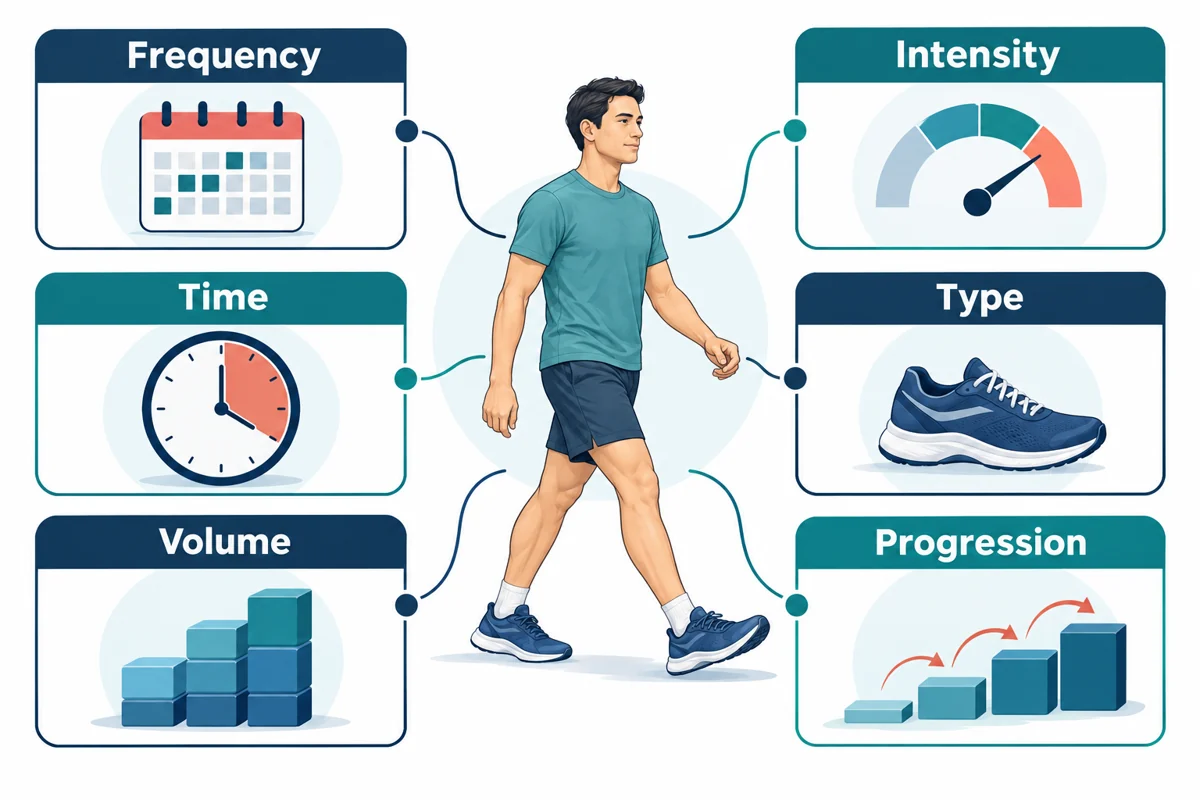
Six fields make an exercise plan interpretable
FITT-VP names six parts of an exercise prescription: frequency, intensity, time, type, volume, and progression. Together they describe how often exercise occurs, how demanding it is, how long it lasts, what activity is performed, the total amount, and how it changes. ACSM uses this framework to organize a plan rather than treating a single weekly target as the entire prescription.
Compare “do more cardio” with a plan that records the mode, days, duration, intended effort, weekly amount, and review rule. The second plan can be checked. If the client finds it too hard, the trainer can identify which field to change. If the client misses sessions, the record shows what actually happened. In exam cases, translate each sentence into its field before judging the program. That small step prevents a change in mode from being mistaken for a change in intensity.
Frequency, time and type answer different questions
Frequency counts the occasions or days of exercise within a stated period, commonly a week. Time describes duration. Type identifies the activity or mode. These fields can vary independently. Cycling four days per week states a frequency and a type, but it leaves the duration and effort unclear. A plan that says “30 minutes” is also incomplete without saying what happens during those minutes.
Use a fictional example: Sam cycles for 20 minutes on three days each week. Changing three days to four changes frequency. Keeping three days but extending each ride to 25 minutes changes time. Replacing a ride with swimming changes type. More than one field may change in a real revision, but a question may ask which one is altered most directly. Identify the deliberate change first, then discuss any additional consequences instead of treating all six letters as interchangeable.
Intensity needs a measure and a context
Aerobic intensity can be described by an external task, such as speed or cycling power, or by the response relative to the individual, such as perceived exertion. The same task can produce different effort in two clients. ACSM's public intensity handout describes heart-rate monitoring, perceived effort, and conversation as tools for judging aerobic exercise effort. A useful prescription states which tool and scale are being used.
If Lee walks at the same speed while the treadmill grade rises, the external demand has changed even though the session still lasts 20 minutes. If Lee repeats the same workload after a difficult night and reports unusually high effort, the session record should preserve both pieces of information: the workload and the response. Avoid writing only “moderate” without explaining how it is monitored. A number on a heart-rate display is also a measurement to interpret, not the whole clinical picture.
Volume is the accumulated dose
Volume describes the total amount of activity. For a simple aerobic plan performed at the same specified intensity, weekly minutes make the accumulation easy to see. Three sessions of 20 minutes produce 60 minutes; four sessions of 20 minutes produce 80 minutes. Those arithmetic examples illustrate volume without assuming that every minute at every intensity has the same physiological meaning.
Two schedules can have the same weekly time but different organization. Five 20-minute sessions and two 50-minute sessions both total 100 minutes. They differ in frequency and session duration, and the client may tolerate or prefer them differently. Keep the accounting separate from the judgment about suitability. For a question asking what increased when an additional session was added, frequency changed directly and total volume rose as a consequence. Stating both relationships is more precise than choosing a letter with no explanation.
Progression is a planned adjustment
Progression describes advancement of the prescription as the person adapts and tolerates the current work. It is not an instruction to increase every variable at once. ACSM's hypertension guidance, for example, recommends gradual changes and avoiding large increases, particularly in intensity. That disease-specific example shows why a progression rule must be fitted to the client instead of copied as a universal weekly percentage.
Imagine a beginner who completes the current walking sessions comfortably. An illustrative next plan might keep the same days and mode while adding a small amount of time, then review the response. This is an example of changing one field so its effect can be understood; it is not a mandatory starting prescription. Record what would pause or reverse that change, including poor tolerance or new symptoms. A progression is only useful when the trainer can explain why the present step is appropriate.
Read the plan against its purpose
A prescription should connect the selected activity and dose to the person's goals, abilities, and health information. General public-health targets describe an eventual amount of activity associated with health benefits; they do not require an inactive person to perform that amount on the first day. The Physical Activity Guidelines emphasize moving more, starting with manageable activity, and building toward an appropriate level.
To check your understanding, write two versions of the same plan: the intended prescription and the activity actually completed. If three 20-minute sessions were planned but only two occurred, the completed frequency and volume differ from the plan. If the client changed from cycling to walking, type differs too. This comparison helps locate the problem before adding more work. Finish each case by naming the changed field, the reason for the change, the measure used to monitor it, and the information needed at the next review.
Put the concept into practice
Answer an original 30-question set for your chosen certification, then review your domain report.
Try 30 free questionsUSD 9.99 · Access detailsSee the current purchase availability and access terms on the product page.
Questions about this topic
What does the V in FITT-VP mean?
Volume is the total amount of exercise, such as accumulated weekly aerobic activity when intensity is specified.
Is treadmill speed the same as personal effort?
No. Speed describes an external task; the relative effort depends on the person and can be monitored with suitable response measures.
Must every FITT-VP field increase each week?
No. Progression should be gradual and individualized; changing every field at once can make tolerance harder to judge.
Official sources
Checked 27 October 2026
- ACSM Certified Personal Trainer preparation and GETP 12 alignment · 2026-10-27
- Physical Activity and Exercise Intensity Terminology: ACSM and ESSA Expert Statement · 2026-10-27
- ACSM Exercise Intensity Infographic · 2026-10-27
- Physical Activity Guidelines for Americans, second edition · 2026-10-27
- Exercise for the Prevention and Treatment of Hypertension: Implications and Application · 2026-10-27
- ACSM-CPT Exam Content Outline, effective July 10, 2025 · 2026-10-27
- ACSM / ESSA statement: publisher abstract and FITT-VP terminology · 2026-10-27