ACSM · Source check: 27 October 2026
ACSM Exercise Prescription for Older Adults: Function, Strength and Balance
Connect aerobic activity, resistance exercise, balance and flexibility with older adults’ functional goals, abilities and progression.
ACSM-CPT scope: Resources for the Personal Trainer, 6th edition; Guidelines for Exercise Testing and Prescription, 12th edition (exam alignment effective July 10, 2025). Public sources below are identified separately by date; this guide does not reproduce the textbook.
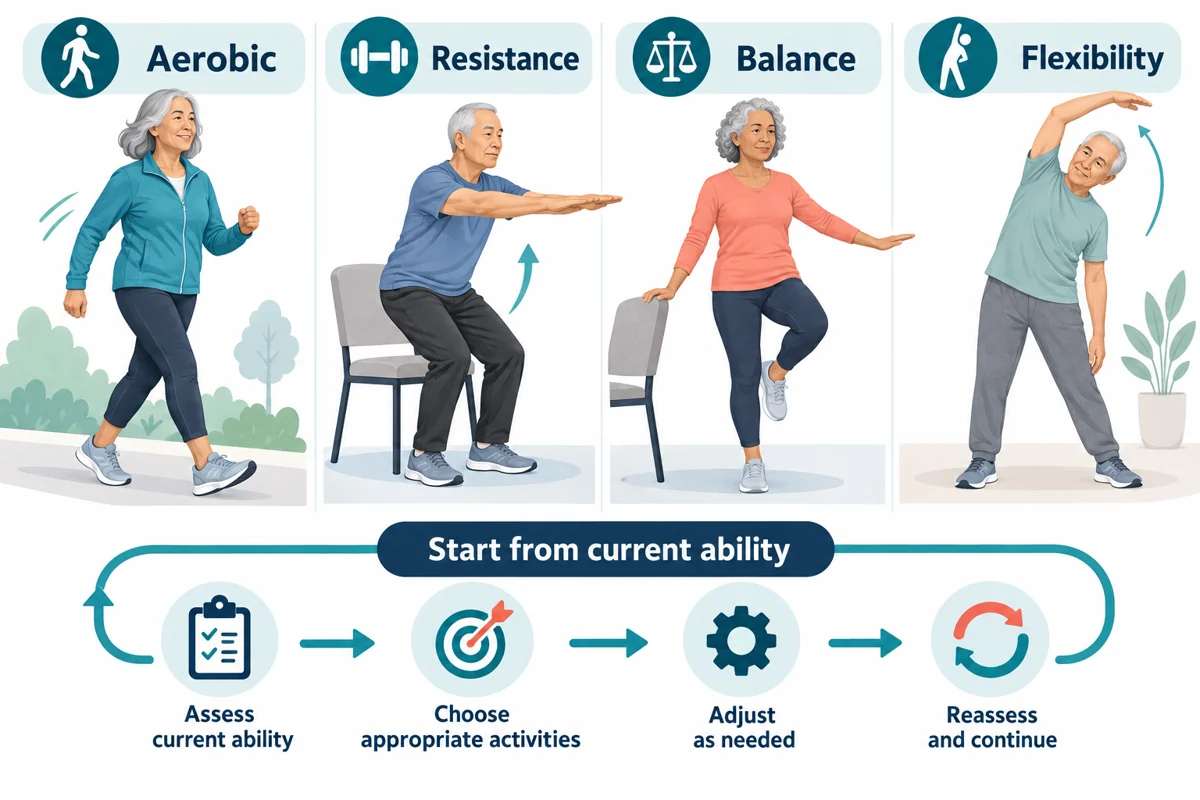
Start with the task the person wants to keep doing
An older adult's program should connect exercise with the person's abilities and goals. ACSM's aging resources cover function, fitness assessment, and exercise prescription, including the older-adult chapter in GETP 12. Age identifies a population, but it does not establish current exercise tolerance or determine a single appropriate starting workload. The consultation still needs health information, present activity, symptoms, and functional priorities.
Ask what the client wants to do more easily: walk to nearby shops, rise from a chair, carry a small bag, or move confidently at home. These are examples of goals to investigate, not tests that every client must complete. Then identify a suitable baseline and an activity that can be taught and monitored. The best-looking exercise on paper is of little use if the person cannot access it, perform it safely, or understand how it connects to their goal.
Build aerobic activity from a tolerable amount
ACSM's Exercise is Medicine handout for older adults recommends building toward weekly aerobic activity while starting with an amount the person can manage. Rhythmic activities can be selected around ability and preference. The handout also emphasizes a gentle warm-up, an easy cool-down, and gradual increases in pace and time. A weekly target is a destination to work toward, rather than a demand that every new client meet it immediately.
Suppose a client can comfortably walk for only a few minutes at a time. An illustrative plan can distribute manageable opportunities through the day and review how the person responds. Write down the completed time instead of recording only the intended target. If the chosen route includes uneven ground or difficult access, change the environment or mode. That is part of making aerobic activity usable, not a failure to follow the broad goal.
Judge effort relative to the individual
Public physical activity guidance distinguishes an activity's absolute demand from the effort it represents for the person performing it. The same pace may be easy for one older adult and demanding for another. A suitable monitoring approach can combine the task, perceived effort, breathing or conversation, symptoms, and relevant clinical advice. The CDC describes the talk test as a simple way to gauge relative aerobic intensity.
For a fictional example, two clients walk together at a common speed. One talks comfortably; the other struggles to finish a phrase. Matching their speed has not matched their effort. The trainer can adjust pace, route, or duration so each person receives an appropriate task. If a medication alters the usual heart-rate response, do not force the client toward an age-predicted display number without the appropriate guidance. Record how intensity is being judged so another professional can interpret the session.
Resistance training should serve daily function
The ACSM older-adult handout includes resistance exercise using weights, bands, machines, or body weight, with at least two days per week and recovery between sessions. It recommends starting with manageable effort and progressing as appropriate. Examples include wall push-ups and chair sit-to-stands. The choice of equipment is less useful as a study shortcut than the fit between the task, the client's ability, and the intended progression.
If standing from a chair is the goal, a supported sit-to-stand from an appropriate seat height may provide a relevant starting task for a medically appropriate client. Document any hand support or assistance. Later changes might concern assistance, repetitions, range, or resistance; select a change that preserves control and fits the person's response. Do not treat a faster or heavier repetition as improvement if the client must use an unplanned strategy that changes the task being trained.
Include balance and flexibility deliberately
Balance training deserves its own place alongside aerobic and muscle-strengthening activity. Public guidelines describe multicomponent activity for older adults, including balance. ACSM's handout gives examples of changing the base of support, walking patterns, and other challenges, with support and professional guidance when needed. Flexibility and range-of-motion work address another component; they do not replace a balance task merely because both look gentle.
Consider a client who can stand securely with a wide base but becomes anxious when the feet move closer together. Select a challenge that can be guarded and performed with suitable support. Removing the support, narrowing the stance, closing the eyes, and adding movement all at once makes the response difficult to interpret. In an illustrative progression, change one demand and check control before adding another. Record the assistance used, since an unsupported task and a supported task are not equivalent measurements.
Progress around health changes and real constraints
Older adults can have several conditions and medications that affect exercise planning. The ACSM-CPT role includes appropriate programming for people with medical clearance, and specialist guidance may be needed for more complex needs. The 2026 consensus for older cancer survivors illustrates this individualization: it emphasizes function, symptoms, environmental hazards, suitable instruction, and the degree of supervision. Those specific recommendations should not be generalized into a diagnosis for every older client.
Use a brief review before each session: changes in health, present symptoms, recovery, confidence, and access to the planned activity. If a client has just returned from an illness or a long break, the previous workload is a historical record, not automatic proof of today's readiness. Choose the appropriate next step using current information. A useful program preserves a clear connection between the person's goal, the exercise selected, the response observed, and the reason to progress, maintain, modify, or refer.
Put the concept into practice
Answer an original 30-question set for your chosen certification, then review your domain report.
Try 30 free questionsUSD 9.99 · Access detailsSee the current purchase availability and access terms on the product page.
Questions about this topic
Should an inactive older adult reach the full weekly target immediately?
No. Start with activity suited to present ability and build gradually toward an appropriate amount.
Can walking replace every other exercise component?
Walking can support aerobic activity, but older-adult guidance also includes muscle strengthening and balance; flexibility addresses another component.
Does chronological age determine the starting resistance?
No. Current ability, health information, exercise experience, goals and response guide the starting task and progression.
Official sources
Checked 27 October 2026
- ACSM Certified Personal Trainer preparation and GETP 12 alignment · 2026-10-27
- Aging: ACSM resources · 2026-10-27
- Being Active as We Get Older, Exercise is Medicine handout · 2026-10-27
- Physical Activity Guidelines for Americans, second edition · 2026-10-27
- CDC How to Measure Physical Activity Intensity · 2026-10-27
- ACSM-CPT Exam Content Outline, effective July 10, 2025 · 2026-10-27
- Exercise recommendations for older adults living with and beyond cancer, 2026 consensus · 2026-10-27