ACE · Source check: 27 October 2026
ACE Functional Assessments: Observe, Record, and Apply
Review ACE posture, movement, balance, and flexibility assessments and use findings to guide a suitable program.
ACE 2020 IFT revision and current ACE public resources, checked 27 October 2026; older four-phase IFT terminology is outside this guide.
Choose an assessment for a decision
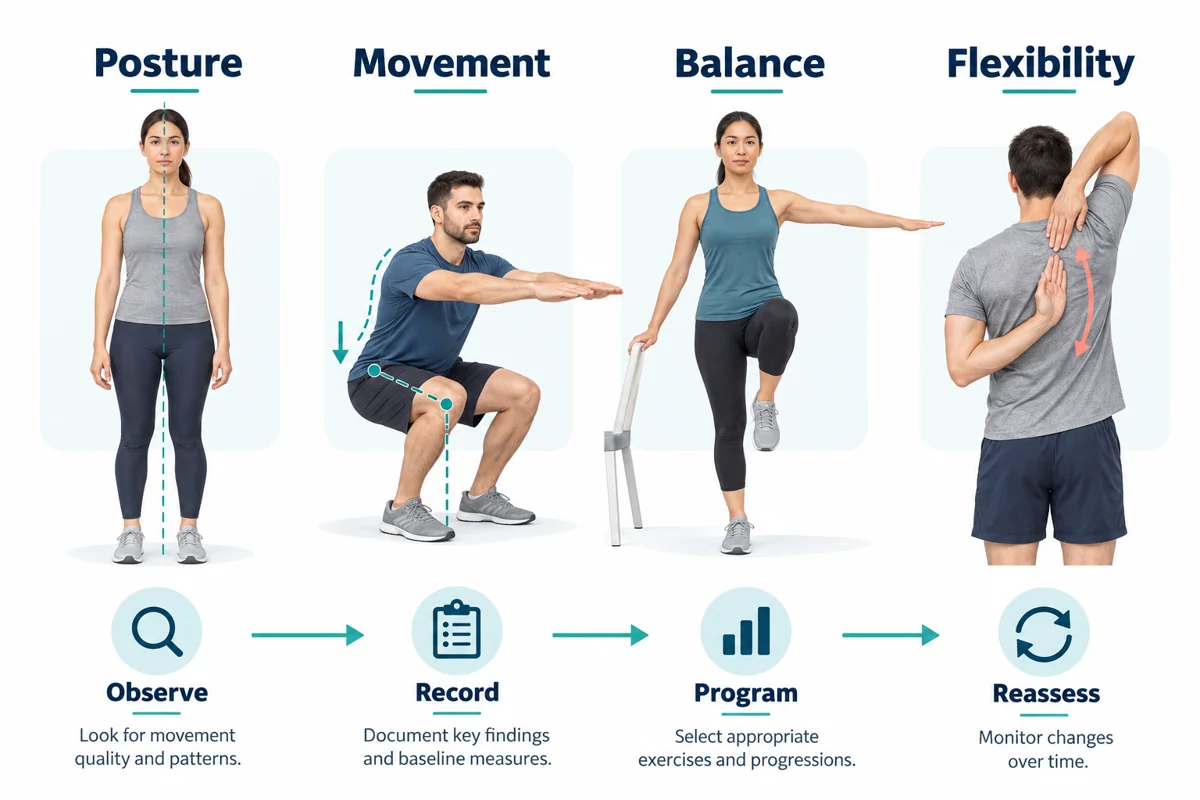
A useful assessment helps answer a programming question. It might establish how the client performs a movement, maintains balance, or accesses a needed range. ACE's public exam-preparation material groups functional assessments into static posture, movement, balance, and flexibility. Those categories describe different information; a result in one category should not be treated as a complete picture of the person.
Begin with the client and the decision, then select a suitable assessment. Collecting every available measurement can make an initial session longer without making the plan better. Explain the purpose and obtain agreement before proceeding. A client who declines one optional measurement can still participate in other appropriate agreed assessments. Respecting that choice is part of professional assessment, not a reason to abandon useful information gathering.
Static posture is an observation at rest
Static postural analysis examines the person in a relaxed standing position. ACE discusses observing areas such as the ankles, hips, pelvis, shoulders, and head. The result describes alignment at rest. It can suggest areas to investigate, but it does not establish exactly how the client will move under every task or prove the cause of pain.
For a fictional learning example, note that one shoulder appears higher in the chosen standing setup. Keep that observation separate from a definitive claim about a specific muscle or structural condition. Next ask which further information would be relevant to the training decision. A static observation can contribute to the assessment while remaining only one part of it. The distinction protects both the accuracy of the record and the logic of exercise selection.
Movement assessment adds task information
ACE provides protocols and forms for primary movement patterns, including bend-and-lift, single-leg tasks, pushing, pulling, and rotation. A movement assessment shows how the client organizes a particular task under specified conditions. Setup, load, support, instructions, and the point in the sequence when a compensation appears can all affect the meaning of the observation.
Suppose a fictional client shows inward knee movement only on later squat repetitions. Record both the direction and when it appears. Writing only a diagnosis of hip weakness loses the task information and adds certainty that was not measured. A good explanation in an assessment question describes what the trainer knows, what remains uncertain, and how the next task can be selected or adjusted from that evidence.
Balance and flexibility answer different questions
Balance assessment concerns the ability to maintain or control the body in the selected task. Flexibility assessment examines available motion under the chosen protocol. ACE supplies separate resources for these purposes. Limited performance in a single-leg balance task and limited shoulder movement are different findings, even if both influence the eventual exercise plan.
For revision, avoid translating every low result into the same instruction to stretch. Ask what the assessment actually challenged. A support change may help a client perform a balance task, while a different setup may be needed to examine a particular joint motion. The purpose is to understand the finding well enough to guide a decision. It is not to attach one exercise to every assessment name regardless of the client's response.
Select demand that matches current skill
Assessment demand should fit the client's health information, ability, and purpose. A beginner who lacks the skill for a planned maximal lifting test is not made ready simply by adding a spotter. A lower-demand assessment or a different way to gather the needed information may be more suitable. The test should serve the program rather than become an obstacle the client must overcome to qualify for help.
A fictional client may be able to practice an unloaded pattern reliably while not being ready for a maximal external load. That supports a different assessment choice, not a conclusion that no assessment is possible. Explain why the substitute provides useful information for the immediate decision. A question asking for the best first adjustment often tests this matching of demand to capacity rather than memorization of the hardest available test.
Link findings to training and reassessment
Within ACE IFT muscular training, Functional Training addresses stability and mobility needs. Movement Training develops primary patterns. Appropriate loading and speed demands follow according to goals and readiness. Assessment helps identify the current emphasis and guides exercise selection, regression, and progression. It is not a permanent grade that must determine every future session.
For a learning example, reduce a demand that disrupts the intended movement and retain a suitable version of the pattern. Later compare the client's performance using consistent conditions. A changed result should be interpreted within the task that was repeated. Do not call it proof that a specific unmeasured muscle mechanism has been corrected. The useful question is whether the evidence now supports changing the program.
Write a record another trainer can use
An assessment record should separate setup, observation, interpretation, and action. Include the task, relevant conditions, and what happened. State a possible contributor as a hypothesis where appropriate. Then explain the exercise decision or need for further assessment. This structure is more useful than a broad label such as poor posture because it allows the reasoning to be checked later.
For practice, rewrite a fictional note that says bad squat into a description of knee path, load, repetitions, and observed trunk control. Add the next decision without inventing a diagnosis. Then identify which assessment category supplied each finding. The questions below test documentation of a late-set observation, respect for a declined measurement, and an appropriate alternative when a planned maximal test exceeds the client's current skill.
Put the concept into practice
Answer an original 30-question set for your chosen certification, then review your domain report.
Try 30 free questionsUSD 9.99 · Access detailsSee the current purchase availability and access terms on the product page.
Questions about this topic
Can static posture replace a movement assessment?
No. Static posture describes the chosen resting position; a movement assessment adds information about a specific task.
Must every client complete a maximal strength test?
No. Assessment selection should fit the purpose, health information, and current ability.
Official sources
Checked 27 October 2026
- ACE Functional Assessments: Static Postural Analysis · 2026-10-27
- ACE Answers: official assessment protocols · 2026-10-27
- ACE Simplifying Assessments for New Clients · 2026-10-27
- ACE IFT model: what changed in 2020 · 2026-10-27
- ACE IFT exercise programming template · 2026-10-27