ACE · Source check: 27 October 2026
ACE Cardiorespiratory Phases: Base, Fitness, and Performance
Connect ACE Base, Fitness, and Performance Training to VT1, VT2, the talk test, and individual readiness.
ACE 2020 IFT revision and current ACE public resources, checked 27 October 2026; older four-phase IFT terminology is outside this guide.
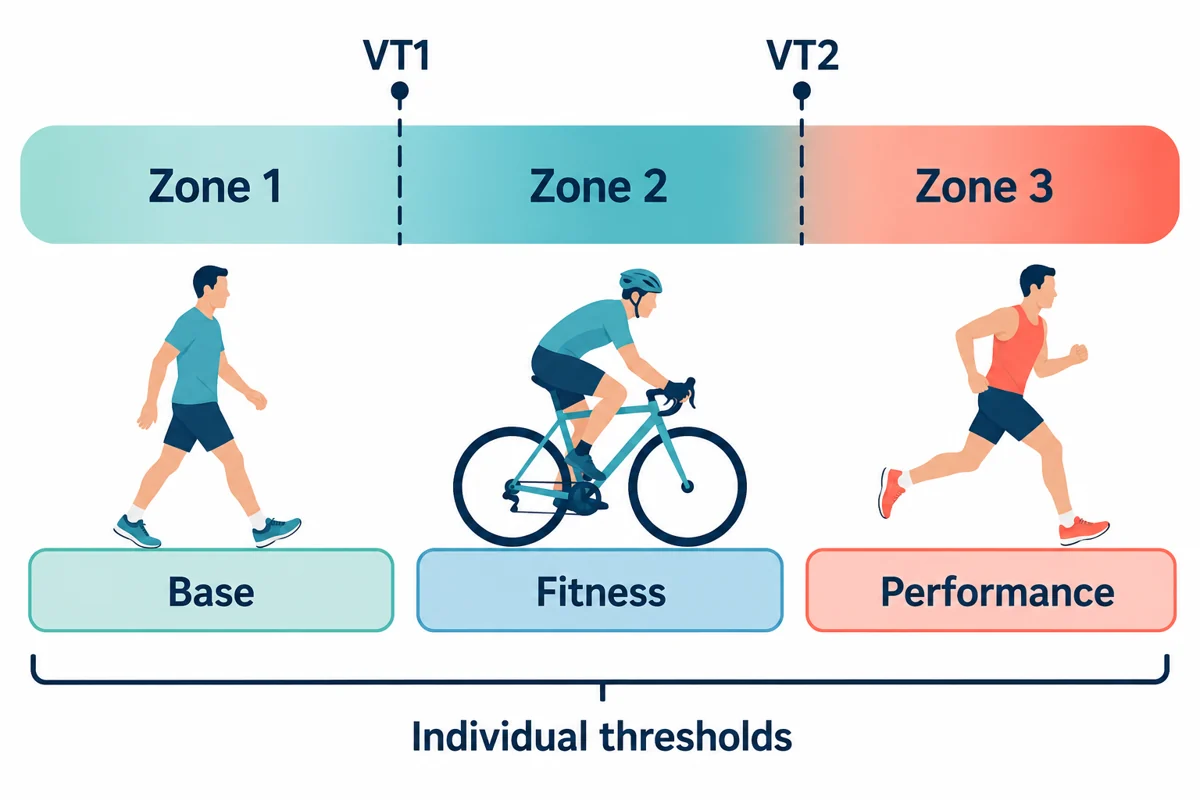
Separate the phase from the zone
ACE's current cardiorespiratory component has three phases: Base, Fitness, and Performance Training. The three-zone intensity model helps organize work within those phases. A phase describes the program emphasis, while a zone describes intensity relative to the individual's ventilatory thresholds. They are related concepts, but they are not interchangeable labels for the same thing.
A Performance Training plan can include easier work. Fitness Training builds on base activity rather than deleting it. These distinctions matter when an answer claims that a client moving to the next phase must spend every session in the newly introduced zone. The model supports selecting and combining demands according to health, fitness, goals, and readiness, with lower-intensity work remaining relevant as appropriate.
Understand the threshold boundaries
Zone 1 is below the first ventilatory threshold, VT1. Zone 2 extends from VT1 to just below the second ventilatory threshold, VT2. Zone 3 begins at VT2. These boundaries are individual physiological markers. They should not be replaced by one fixed heart rate that is assumed to apply to every client of the same age.
For study, draw two vertical lines and label them VT1 and VT2. Place zone 1 before the first line, zone 2 between the lines, and zone 3 at and beyond the second. Then add the phase names on a separate row to show how programming builds across the zones. This prevents a common mix-up in which a threshold is remembered as a phase number rather than an intensity boundary.
Base Training builds suitable participation
Base Training emphasizes zone 1 activity and the establishment of regular participation. Comfortable conversation is a practical cue for work below VT1. For a previously inactive client, the immediate priority can be an appropriate routine that is manageable within everyday life. Choosing a difficult session because it produces more visible effort does not address the same objective.
Imagine a fictional person who repeatedly starts vigorous workouts and stops after a few sessions. The case calls for attention to readiness, feasible activity, and consistency. The point is not that all effort must remain easy forever. It is that the starting demand should support the present goal and capacity. A maximal test is not automatically necessary to choose a suitable initial conversational walking pace.
Fitness Training introduces zone 2 intervals
Fitness Training adds controlled work in zone 2 while building on base activity. In the current template, zone 2 begins at VT1 and remains below VT2. The relevant distinction is the newly introduced demand, rather than simply a longer session or an arbitrary percentage printed on a generic heart-rate chart.
For a learning case, an established routine and readiness for suitable intervals help support this phase choice. The interval plan still needs recovery and individualization. A client who cannot maintain the task as intended may need an adjustment rather than an insistence on the original demand. When reviewing an item, identify the boundary crossed and the upper limit of the proposed work. That explains why an interval below VT2 differs from a zone 3 effort.
Performance Training adds higher-intensity work when appropriate
Performance Training uses an appropriate periodized combination of intensities, including zone 3 intervals at and above VT2. An endurance-event objective can help explain why this emphasis is relevant for a prepared client. The phase is not a compulsory destination for everyone who wants to improve general health or maintain a useful activity routine.
In a fictional comparison, one client wants reliable moderate activity while another is prepared for an endurance performance goal. The goal and readiness findings explain the different emphasis. They do not establish a universal interval dose. Read the problem's scope carefully: identifying the phase or zone is different from prescribing the exact number, duration, and recovery of intervals for a particular medical or training situation.
Distinguish the informal talk test from a formal assessment
The informal talk test uses the person's ability to speak comfortably while exercising. It is a field estimate for monitoring intensity. ACE distinguishes this from the submaximal talk test for VT1, which is a prepared assessment that monitors heart rate during gradually increased work to identify the heart-rate response associated with the threshold.
A wearable heart-rate value alone does not turn an ordinary conversation into a completed threshold protocol. Likewise, an age-predicted maximum is not a measured VT1. In a study case, name what was actually assessed and which information is available. This helps avoid false precision. If a question gives an individual measured threshold, do not discard it merely because a simpler age-based estimate produces a familiar percentage.
Use multiple pieces of client information
Phase selection and intensity monitoring sit within a wider assessment and planning process. Client history, screening, goals, present activity, and response to the task all matter. A phase title is not permission to ignore concerning symptoms or to keep increasing demand when the person cannot perform the intended work. Protocols and professional competence guide the assessment choices.
For revision, explain each phase in two parts: the client need and the intensity emphasis. Then explain each zone using VT1 and VT2 without mentioning a phase number. Finally, distinguish a conversational cue from a formal heart-rate threshold assessment. These three short exercises test different concepts that are easy to blur together. The questions below focus on the initial Base cue, the zone 2 interval boundary, and where zone 3 starts.
Put the concept into practice
Answer an original 30-question set for your chosen certification, then review your domain report.
Try 30 free questionsUSD 9.99 · Access detailsSee the current purchase availability and access terms on the product page.
Questions about this topic
Does zone 2 begin at VT2?
No. Zone 2 starts at VT1 and extends to just below VT2; zone 3 starts at VT2.
Is a casual talk test a measured VT1 heart-rate protocol?
No. ACE distinguishes informal intensity monitoring from the prepared submaximal assessment that monitors heart rate.
Official sources
Checked 27 October 2026
- ACE IFT model: what changed in 2020 · 2026-10-27
- ACE IFT exercise programming template · 2026-10-27
- ACE Talkin About the Talk Test (January 2025) · 2026-10-27
- ACE Answers: official assessment protocols · 2026-10-27
- ACE Body-weight Training by Design (September 2026) · 2026-10-27
- ACE Integrated Fitness Training model · 2026-10-27