ACE · Source check: 27 October 2026
ACE ABC Approach: Ask, Break Down Barriers, Collaborate
Apply the ACE Mover Method with open-ended questions, barrier exploration, and a next step chosen with the client.
ACE 2020 IFT revision and current ACE public resources, checked 27 October 2026; older four-phase IFT terminology is outside this guide.
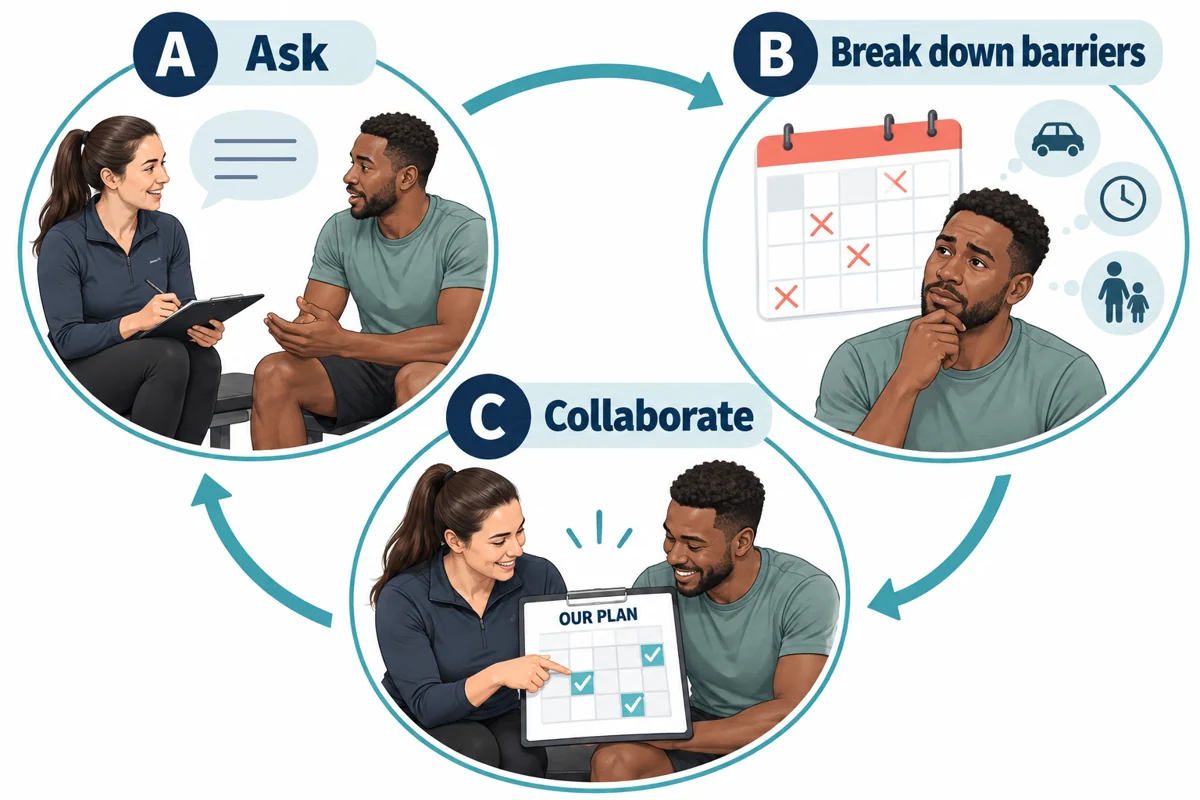
Know which ABC the question means
In the ACE Mover Method, ABC stands for Ask open-ended questions, Break down barriers, and Collaborate. This guide uses that ACE framework. Other behavior models also use the letters ABC, so the acronym alone is not enough to identify the intended model. Read the source context and the wording of the task before applying a definition from a different framework.
The ACE approach keeps the client involved in decisions. The trainer brings exercise knowledge, while the client brings knowledge of personal priorities, circumstances, and preferences. A technically sound suggestion can still be a poor first response if it ignores what the client is trying to accomplish. The aim is to understand the situation well enough to agree on a realistic next step.
A: Ask open-ended questions
Open-ended questions invite explanation rather than a brief yes or no. They help the trainer understand the client's goal and experience. Asking what makes a walking routine difficult gathers different information from asking whether the client knows exercise is beneficial. The first invites the person's perspective; the second can end the conversation before the practical barrier becomes clear.
For a fictional client who misses evening sessions, a useful question explores what evenings currently involve and which options seem realistic. This is different from immediately prescribing an early-morning schedule. A question can be open in grammar yet still be judgmental in tone. The practical test is whether it makes room for the client's explanation instead of using a question mark to deliver a reprimand or a predetermined answer.
Listen before solving
Active listening is part of ACE's client-centered communication. The purpose is not only to wait until it is the trainer's turn to speak. It is to understand the meaning and constraints behind the client's answer. A brief reflection or summary can help check whether the trainer understood the situation accurately before moving to possible changes.
Suppose a fictional client says the gym closes before the new work shift ends. Interpreting this as poor motivation skips the concrete scheduling problem. Summarize the mismatch and ask about feasible alternatives. The trainer may have useful options, but listening establishes which options are relevant. In a question that asks for the first response, information gathering can be more appropriate than jumping straight to a replacement program.
B: Break down barriers
Barrier exploration examines what stands between the client and the desired behavior. Barriers may involve time, access, confidence, preferences, or competing responsibilities. The trainer should not assume the same solution fits every person. An exercise option that removes travel may be useful for one client and unacceptable to another who values the gym environment or lacks space at home.
In a study case, separate the barrier from the proposed solution. Childcare is a circumstance to understand; a home session is one possible option. The option becomes relevant when it fits what the client can and wants to do. This distinction prevents advice from sounding collaborative while actually substituting the trainer's preference for the client's. Ask which part of the situation can realistically change before deciding what the new plan must be.
C: Collaborate on the next step
Collaboration means choosing the next step with the client. It can produce a specific goal or a small action that the client is ready to attempt. A plan is more concrete when it describes the behavior and when or where it will happen. Specificity helps both people understand what they have agreed to review, without turning the conversation into a promise of a particular result.
For a fictional case, the client might choose two short walks on days with a predictable break. The trainer can help clarify the arrangement and ask how progress will be recorded. The example is not a universal activity prescription. Its purpose is to show shared decision-making. The same numerical target imposed without discussion would illustrate a different process even if the written activity looked identical.
Review attempts without making the client defend them
Behavior-change support continues after a plan is written. When a client reports completing two planned walks, specific acknowledgment and curiosity about what helped can guide the next decision. Immediately doubling the target may overlook the circumstances that made the first attempts possible. Likewise, focusing only on a missed session can erase useful information about a successful one.
A fictional return after disrupted attendance is an opportunity to reassess the plan. Ask what changed and what a feasible restart would look like. The ABC approach is available throughout the professional relationship, not only during intake. Collaboration can involve retaining a useful plan, simplifying it, or choosing a different option. Progress is not defined by making every new plan larger than the previous one.
Distinguish coaching from pressure
A client-centered answer preserves professional boundaries and the client's role in decisions. It does not require the trainer to approve an unsafe request, diagnose a psychological condition, or provide services outside competence. The ACE Mover Method is a communication framework, not a replacement for a health-coaching qualification or clinical care when those services are needed.
For revision, take one case and write three responses: an open question, a barrier summary, and a collaborative next step. Check whether each response uses information the client actually supplied. Then compare it with a directive answer that assumes the problem and solution. This exercise makes the framework visible in ordinary language. The questions below use existing bank cases about a schedule conflict, autonomy, and reinforcement. Review the alternatives for premature solutions as well as for factual errors.
Put the concept into practice
Answer an original 30-question set for your chosen certification, then review your domain report.
Try 30 free questionsUSD 9.99 · Access detailsSee the current purchase availability and access terms on the product page.
Questions about this topic
What does ABC mean in the ACE Mover Method?
Ask open-ended questions, Break down barriers, and Collaborate.
Is the ABC approach only for a first meeting?
No. ACE describes it as useful across client interactions, including changing goals and new barriers.
Official sources
Checked 27 October 2026
- ACE Mover Method · 2026-10-27
- ACE Applying the Mover Method with ABC · 2026-10-27
- ACE Implementing the Mover Method · 2026-10-27
- ACE Using Mover Method with IFT · 2026-10-27
- ACE Simplifying Assessments for New Clients · 2026-10-27