ACE · Source check: 27 October 2026
ACE Client Relationship Stages: Rapport, Investigation, Planning, Action
Use the ACE RIPA sequence to connect trust, health information, a shared plan, and exercise delivery.
ACE 2020 IFT revision and current ACE public resources, checked 27 October 2026; older four-phase IFT terminology is outside this guide.
Know what the four stages describe
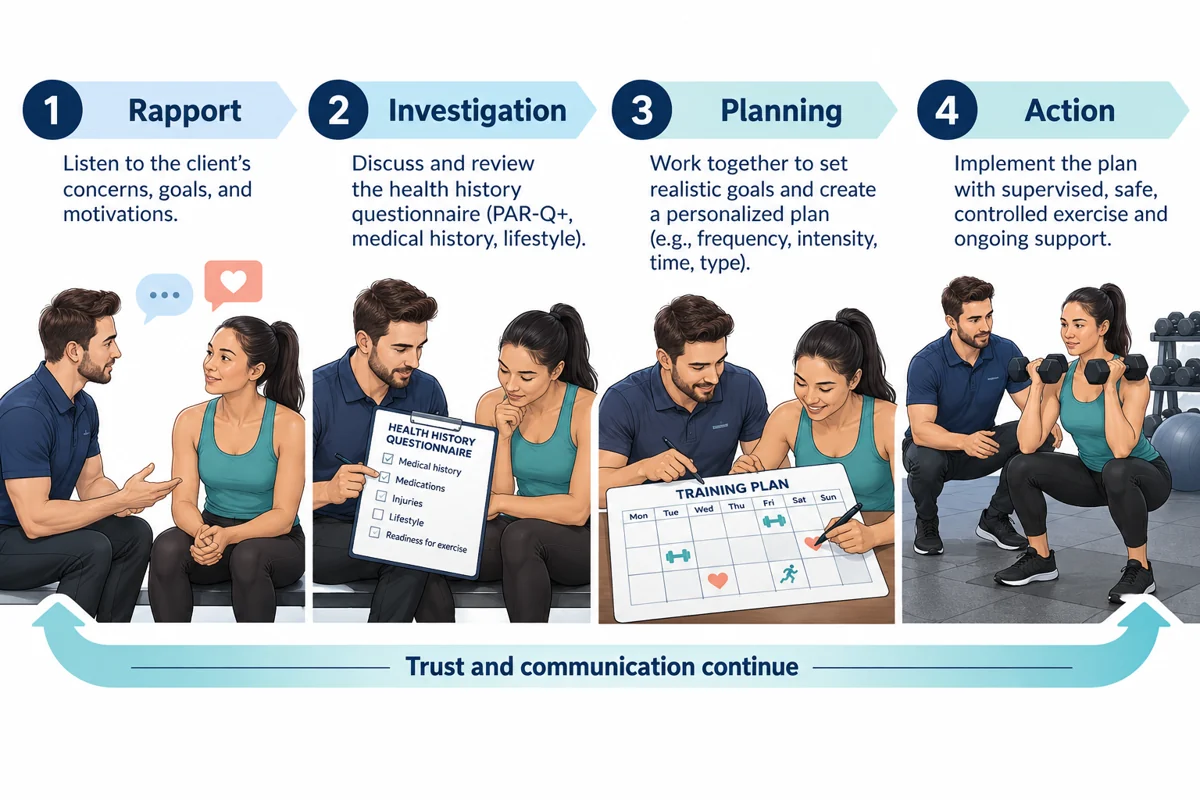
ACE describes four stages of the client–exercise professional relationship: rapport, investigation, planning, and action. The acronym RIPA helps remember the sequence. These stages organize the relationship and the work of understanding, planning, and delivering exercise. They are not four cardiorespiratory training phases and should not be confused with older versions of the IFT model.
The stages are connected. Trust remains important while health information is collected, and communication continues during exercise. A client can also bring a new concern that requires returning to investigation or revising a plan. The sequence helps identify the purpose of the current interaction. It does not require pretending that rapport is permanently finished once the trainer moves to the next task.
Rapport: establish a workable relationship
Rapport involves trust, open communication, and a sense that the client's perspective matters. The trainer listens to goals, concerns, and preferences rather than assuming that a standard introduction fits everyone. The ACE Mover Method emphasizes open-ended questions and active listening. These behaviors help the trainer understand the person who will have to use the plan outside the appointment.
Imagine a fictional client who feels anxious in a busy weight room. Launching directly into a demanding test may ignore the concern that brought the anxiety into the conversation. A more useful response acknowledges the experience and explores a manageable way to begin. This does not mean promising that all anxiety will disappear. It means using the client's information to shape a professional and feasible first interaction.
Investigation: gather relevant information
During investigation, the trainer collects information that supports appropriate exercise decisions. ACE discusses health history, preparticipation screening, goals, activity experience, and assessment in this context. Rapport continues while these questions are asked. Explain why information is needed and avoid turning the conversation into an unexplained interrogation or a search for a reason to reject the client.
For a learning case, a client may want easier stair climbing. Relevant investigation includes what currently happens on stairs, the client's health information, and which suitable assessments can inform the program. The trainer should not replace the stated functional goal with a preferred appearance target. Investigation provides a basis for planning; it does not authorize diagnosing disease from a questionnaire or assuming that one test result explains every limitation.
Planning: agree on goals and the approach
Planning turns the information gathered into a suitable exercise approach and a shared next step. The client and trainer clarify what progress would look like and which practical arrangement is workable. ACE's ABC approach supports collaboration rather than imposing a plan based only on the trainer's habits or assumptions about motivation.
Suppose a fictional client wants to carry groceries upstairs more easily. A plan should connect the exercise emphasis and progress review to that goal. It should also account for schedule, access, preferences, and the capacity observed during investigation. A written target can be specific yet poorly chosen if the client did not help establish it. The planning skill is not merely producing numbers; it is making an informed agreement that can be put into practice.
Action: deliver, observe, and adjust
Action includes implementing the agreed program, teaching and supervising suitable tasks, and observing the client's response. It is more than handing over a list. Information gathered during exercise can support adjustments to the current task or to the broader plan. The trainer continues to communicate, check understanding, and connect the work to the client's goals.
In a fictional session, an added resistance disrupts a previously controlled movement. The appropriate response may be to reduce the demand and retain a useful version of the task. Calling the session action does not mean the plan can no longer change. It means the plan is being tested in practice. What the client actually does supplies evidence for the next decision, rather than mere compliance with what was written earlier.
Use ABC across the relationship
Ask, Break down barriers, and Collaborate are communication skills that can be used throughout RIPA. They help identify a goal during rapport, explore circumstances during investigation, choose a step during planning, and revise a task during action. The frameworks answer different questions: RIPA describes the relationship process, while ABC helps structure a client-centered conversation within it.
For example, a long-term client whose work schedule changes still benefits from open questions and shared planning. The trainer does not need to treat the new barrier as a failure to obey an old agreement. Likewise, a report of two successful walks creates an opportunity to ask what helped. Useful reinforcement names the behavior and gathers information, rather than automatically increasing the target or offering praise with no connection to the actual attempt.
Classify the purpose, then choose the response
When a question asks which stage is occurring, identify the main purpose of the interaction. Building trust points toward rapport; collecting relevant history points toward investigation; agreeing on the program points toward planning; delivering and monitoring it points toward action. Some behaviors appear in more than one stage, so use the purpose rather than one isolated word as the deciding clue.
For revision, write a four-sentence fictional consultation with one sentence for each stage. Then add a new barrier after the first month and explain how the conversation changes. This shows why a useful sequence can still be flexible in practice. The questions below use existing bank cases about a nervous beginner, a functional goal, and reinforcement. Examine whether each response respects the client's perspective and uses the information available at that moment.
Put the concept into practice
Answer an original 30-question set for your chosen certification, then review your domain report.
Try 30 free questionsUSD 9.99 · Access detailsSee the current purchase availability and access terms on the product page.
Questions about this topic
Is rapport finished once investigation starts?
No. Trust and effective communication continue through investigation, planning, and action.
Are RIPA and ACE ABC the same framework?
No. RIPA describes relationship stages; ABC structures client-centered communication throughout the relationship.
Official sources
Checked 27 October 2026
- ACE Using Mover Method with IFT · 2026-10-27
- ACE Simplifying Assessments for New Clients · 2026-10-27
- ACE Mover Method · 2026-10-27
- ACE Applying the Mover Method with ABC · 2026-10-27
- ACE Implementing the Mover Method · 2026-10-27
- ACE Integrated Fitness Training model · 2026-10-27