NASM · Source check: 27 October 2026
NASM OPT Model: Five Phases and How to Tell Them Apart
Learn the five NASM OPT phases, their training goals, and the difference between strength–stabilization and strength–power supersets.
NASM Essentials of Personal Fitness Training, 7th edition terminology; official public resources cross-checked 27 October 2026. Consult the official errata for corrections.
Start with the adaptation
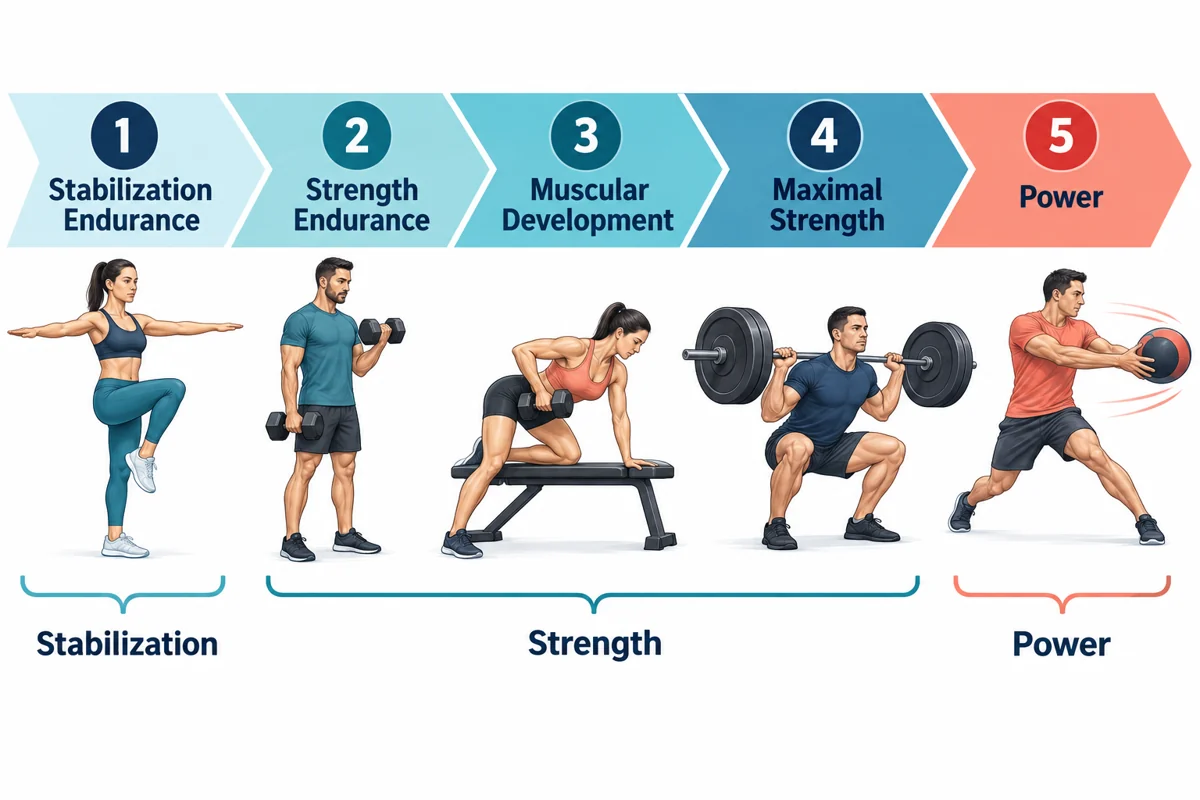
The OPT model organizes training decisions around what a client needs to develop. Its five phases sit within three levels: stabilization, strength, and power. A phase name describes the emphasis of a training block. It does not mean that every other fitness quality disappears from the program. A useful study question is therefore: what adaptation makes this phase the best match for the case?
This guide uses the seventh-edition name Muscular Development for Phase 3. NASM also uses Hypertrophy in public explanations. Those labels refer to the same muscle-growth emphasis. Keep the edition label beside your notes so a wording change does not look like a sixth phase. The scenarios below are learning examples, not exercise prescriptions.
Phase 1: Stabilization Endurance
Phase 1 develops movement quality, postural control, and endurance of the systems that support joint stability. NASM lists 12–20 repetitions for resistance exercises in its public OPT explanation, with slower movement and reduced resistance. The central idea is maintaining control through the task. Merely choosing a light dumbbell does not establish the phase if the client cannot keep the intended alignment.
For example, a fictional client repeatedly loses trunk position in an otherwise light exercise. Increasing weight would not directly address the observed limitation. A more suitable learning answer emphasizes control and an achievable task. When control improves, an appropriate increase in proprioceptive demand can progress the challenge. Instability is a tool selected for the person, rather than a requirement to put every exercise on a moving surface.
Phase 2: Strength Endurance
Phase 2 combines a strength exercise with a biomechanically similar stabilization exercise in a superset. The order matters: the stable strength movement comes first, followed by its stabilization counterpart. This pairs the demand to produce force with the demand to maintain control while continuing to work. The word endurance alone is not enough to distinguish it from Phase 1.
Imagine a controlled bench press followed by a suitable stabilization push-up. The exercises share a pushing pattern, but the second changes the stability demand. A heavy press followed by an explosive medicine-ball throw represents a different pairing. When comparing answer choices, identify both the movement relationship and the purpose of the second exercise. An unrelated stretch is not the matching stabilization half simply because it follows a strength set.
Phase 3: Muscular Development
The main emphasis of Phase 3 is increasing muscle size. NASM's public model describes a higher-volume approach with moderate-to-high resistance intensity. Remember the adaptation before memorizing numerical ranges. A case that prioritizes hypertrophy, adequate movement skill, and recovery points toward Muscular Development rather than toward the phase built around maximal force in a single effort.
Strength and muscle growth can overlap. That overlap does not make the phase names interchangeable. In a fictional comparison, two clients both perform resistance exercise, but one wants additional muscle size while another wants the greatest controllable force in a lift. Their goals supply the distinction that an exercise name alone cannot provide. Sets, repetitions, resistance, tempo, and recovery should form a coherent prescription for the selected emphasis.
Phase 4: Maximal Strength
Phase 4 emphasizes maximal force production. NASM describes heavier resistance, fewer repetitions, and increased recovery compared with higher-volume muscle-development work. A slow-looking heavy lift is not automatically a stabilization exercise; the relevant question is whether the program is organized around force output or around prolonged postural control.
Consider a prepared lifter whose primary goal is improving a strong single effort. Adding many fatigued repetitions would change the demand, even if the bar remained heavy. In an exam case, look for the combination of goal, load relative to capacity, repetition demand, and recovery. Do not use external kilograms as the entire definition of intensity. The same mass can be a very different challenge for two people with different capacities.
Phase 5: Power
Power training emphasizes expressing force quickly. NASM's public OPT description pairs a heavy strength exercise with a biomechanically similar explosive exercise. A controlled squat followed by an appropriate explosive squat task illustrates the relationship; a squat followed by a single-leg balance hold illustrates a different training emphasis. The second exercise reveals whether the pairing is strength–power or strength–stabilization.
Speed quality matters to the goal. A client does not reach this phase merely because a calendar says the prior block is over. Goals, readiness, and reassessment guide progression. A general fitness client may have no reason to make high-level power the program's destination. The model can cycle through phases as needs change, including a return to stabilization work after a demanding block.
Work through a case in a fixed order
For practice, read the client's goal first, then the observed movement capacity, and then the proposed exercise pairing. If the goal is muscle size, label the adaptation before inspecting the set scheme. If the case includes two exercises, ask whether the second develops stabilization or explosive speed. Finally, check that the prescribed variables support the intended phase rather than contradict it.
A useful revision exercise is to change one detail in a fictional case. Replace a stabilization push-up with an explosive throw and explain why the phase identification changes. Replace a muscle-size goal with maximal force and explain which prescription variables need reconsideration. This trains reasoning across the model instead of attaching a phase number permanently to one piece of equipment. Use the three questions below to test those distinctions, then review the explanation for every option.
Put the concept into practice
Answer an original 30-question set for your chosen certification, then review your domain report.
Try 30 free questionsUSD 9.99 · Access detailsSee the current purchase availability and access terms on the product page.
Questions about this topic
Are there five phases or three?
There are five phases within three levels. The strength level contains Phases 2, 3, and 4.
Is Muscular Development different from Hypertrophy?
In this OPT context they name the Phase 3 muscle-growth emphasis. Check the terminology in your edition.
Official sources
Checked 27 October 2026
- NASM seventh-edition textbook errata · 2026-10-27
- NASM textbook errata notice · 2026-10-27
- NASM Optimum Performance Training model · 2026-10-27
- NASM OPT programming guide · 2026-10-27
- NASM Periodization Training Simplified · 2026-10-27
- NASM Strength Training for Women · 2026-10-27