NASM · Source check: 27 October 2026
NASM Postural Assessment: Overactive and Underactive Muscles
Connect overhead-squat observations to probable NASM muscle contributors without treating a movement screen as a diagnosis.
NASM Essentials of Personal Fitness Training, 7th edition terminology; official public resources cross-checked 27 October 2026. Consult the official errata for corrections.
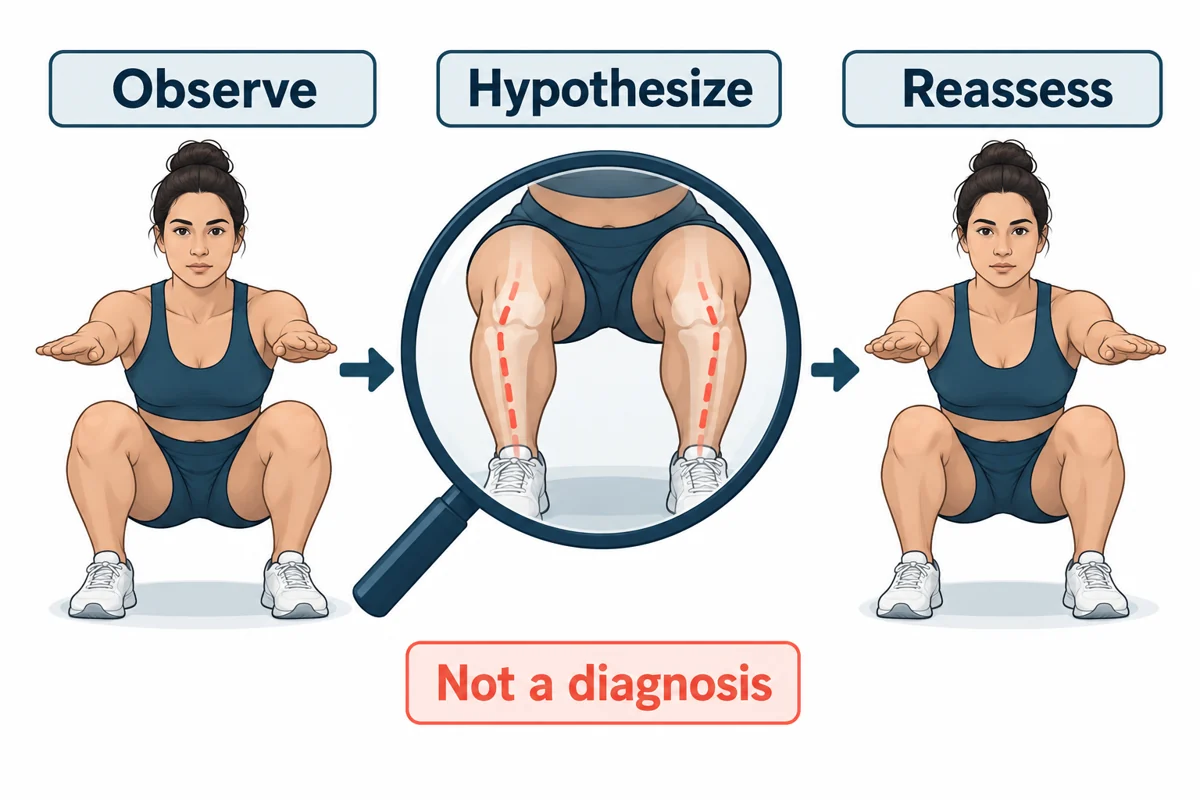
Separate what you see from what you infer
An overhead squat can show a foot turning out, a knee moving inward, or an arm drifting forward. Those are observations. A proposed overactive or underactive muscle is an interpretation that needs context. NASM uses these patterns to guide assessment and exercise selection. The screen does not prove an injury or identify a single cause by itself.
This distinction helps with both study and professional documentation. Write the movement and the conditions before writing a muscle hypothesis. A note such as knees moved inward during later repetitions tells another professional what happened. A note declaring a confirmed ligament problem makes a claim that the movement screen cannot establish. The aim is an informed training decision within a personal trainer's role.
Use the checkpoints and views
NASM organizes observations around the kinetic chain, including the feet and ankles, knees, lumbo-pelvic-hip complex, shoulders, and head. Front and side views reveal different information. The front view is useful for noting knee direction and foot position. The side view helps identify forward lean, lumbar arching, and the relationship between arms and trunk.
During revision, draw a simple two-column record: view and observed compensation. Put the muscle names on a separate line. This prevents a common reasoning error in which a familiar muscle name replaces an actual observation. Keep setup consistent when comparing repetitions or retesting. A change in stance, task, or support is relevant information, not a detail to erase because the final squat looks different.
Feet turning out
NASM's seventh-edition assessment template lists the soleus, gastrocnemius, and hamstrings complex among overactive contributors to feet turning out. Its underactive column includes the anterior and posterior tibialis and the gluteus maximus and medius. Interpret these entries as assessment hypotheses rather than direct measurements of each muscle's activity. The template is a study framework, not proof that every person with the same foot position has the same underlying mechanism.
Use the table that belongs to the stated edition and resource. Older NASM solutions tables may separate muscle heads and use different entries, so do not merge several tables into one supposedly exact list. In a study case, connect the observed compensation to the named pattern before choosing a proposed target. Then ask whether the follow-up information supports that target for this individual task and setup.
Knees moving inward
For inward knee movement, NASM's table includes the adductor complex and tensor fasciae latae among probable overactive contributors. It includes the gluteus medius and maximus among probable underactive contributors. Learn these as linked hypotheses within this assessment system. Do not turn them into a rule that every visible inward knee movement proves weakness in one specific muscle.
For a fictional client, note whether the pattern occurs immediately, only with added load, or later in the set. Those conditions help describe the task and guide a follow-up decision. If an answer option jumps straight from visible movement to a definitive diagnosis, it skips the necessary distinction between observation and inference. Appropriate programming begins with the findings and stays open to additional assessment.
Forward lean, low-back arch, and falling arms
Several compensations can involve overlapping probable contributors. NASM lists calf and hip-flexor tissues in the forward-lean pattern, while hip flexors, spinal erectors, and latissimus dorsi appear in the low-back-arch pattern. Falling arms can involve the latissimus dorsi and pectoral muscles. The exact compensation matters more than a general impression that a client looks tight.
NASM discusses heel elevation and changes in arm position as ways to gather more information about a squat. A changed result can help refine the assessment hypothesis. It does not turn one modification into a definitive medical test. Keep the observation, the modification, and the response in the record. This preserves the reasoning behind the next exercise choice instead of hiding it behind a broad posture label.
Connect findings to the corrective continuum
NASM's corrective exercise continuum uses inhibit, lengthen, activate, and integrate. Where appropriate, self-myofascial techniques address a selected overactive target, stretching addresses the relevant length restriction, isolated strengthening addresses an underactive target, and integrated movement brings the task back together. The sequence describes the role of each intervention, not a guarantee that any single exercise fixes the pattern.
In a learning example, rolling an identified area belongs to inhibition rather than activation. A static stretch fits lengthening. A selected isolated strengthening exercise fits activation. A whole-body task fits integration. The exercise must still match the assessment and the individual's capacity. A memorized sequence cannot replace determining whether a proposed target is supported by the findings in the case.
Retest without overclaiming
An assessment becomes useful when it changes a decision and can be compared with a later result. Record the setup, compensation, modification, and training response. Reassessment may support changing the task or progression. Improved performance in that task shows improved task performance; it should not be described as proof that every proposed muscle mechanism was correct.
Pain or other concerning symptoms require stopping the provoking assessment and referring as appropriate. Personal trainers do not diagnose the source of pain. For revision, practice replacing absolute language with accurate language: observed, possible contributor, further assessment, and reassess. Then explain which action follows from the information available. The three questions below test a muscle hypothesis, an activation target, and the boundary between a screen and a diagnosis.
Put the concept into practice
Answer an original 30-question set for your chosen certification, then review your domain report.
Try 30 free questionsUSD 9.99 · Access detailsSee the current purchase availability and access terms on the product page.
Questions about this topic
Does inward knee movement prove gluteus medius weakness?
No. NASM lists probable contributors, which should be interpreted with the task conditions and follow-up assessment.
Is a movement screen a diagnosis?
No. It helps guide training assessment and programming; pain and suspected injury require appropriate referral.
Official sources
Checked 27 October 2026
- NASM seventh-edition textbook errata · 2026-10-27
- NASM textbook errata notice · 2026-10-27
- NASM overhead squat assessment guide · 2026-10-27
- NASM Corrective Exercise Continuum · 2026-10-27
- NASM CPT7 static and dynamic postural assessment template · 2026-10-27
- NASM overhead squat assessment guide: modifications · 2026-10-27
- NASM CPT7 exam blueprint · 2026-10-27