NASM · Source check: 27 October 2026
NASM Acute Variables: Sets, Reps, Load, Tempo, and Rest
Identify what changed in a NASM training prescription and how acute variables work together across OPT phases.
NASM Essentials of Personal Fitness Training, 7th edition terminology; official public resources cross-checked 27 October 2026. Consult the official errata for corrections.
Describe the prescription before naming the phase
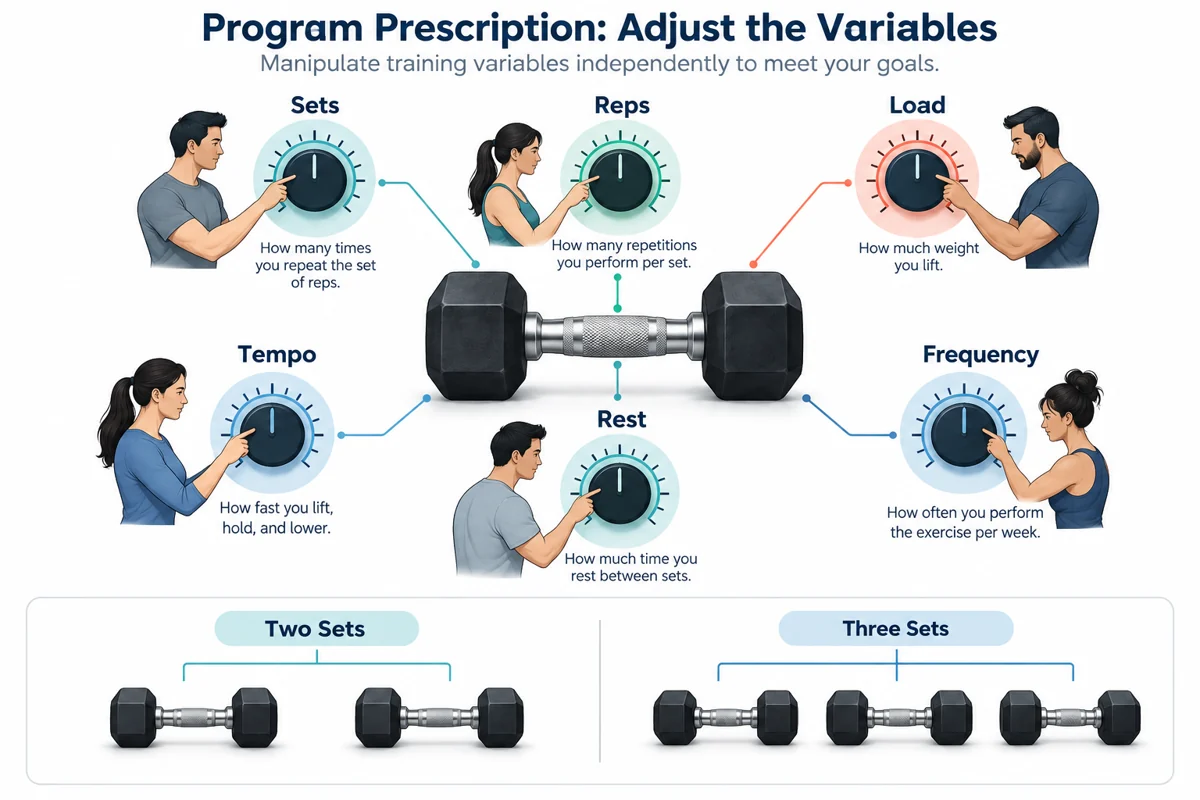
Acute variables are the adjustable parts of a training prescription. NASM's public program-design material includes repetitions, sets, intensity, tempo, volume, rest, frequency, duration, and exercise selection. These variables describe what the person will do and how the work is organized. A phase name gives the emphasis, but it does not replace a usable prescription.
For study, compare two versions of a workout and ask exactly which entry changed. If a coach adds a work set while repetitions and resistance stay the same, the direct change is the number of sets. Total work also changes as a consequence. Identifying the direct variable first prevents a vague answer such as the workout became harder from replacing the specific concept the case is testing.
Repetitions and sets
A repetition is one completed exercise cycle; a set groups repetitions before the planned break or transition. Three sets of eight repetitions and two sets of twelve both contain twenty-four repetitions, but they organize that work differently. This arithmetic example does not claim that the two prescriptions produce identical responses. It shows why a total alone does not describe the session.
If a fictional log changes from two sets of eight to three sets of eight, the set count changes while the repetitions per set remain constant. If it changes from three sets of eight to three sets of ten, the repetitions change. Read the unit attached to each number. Many errors come from answering with total repetitions when the question asks about repetitions in one set.
Resistance intensity is relative to capacity
For resistance programming, relative load is commonly expressed as a percentage of the person's one-repetition maximum for the task. External kilograms and relative intensity answer different questions. A twenty-kilogram load compared with a forty-kilogram maximum is fifty percent; the same load compared with an eighty-kilogram maximum is twenty-five percent. These are arithmetic illustrations, not instructions to perform a maximal test.
Use the correct capacity estimate for the exercise and conditions described. A bench-press estimate should not automatically become the denominator for a different movement. When an item asks which client is working at a higher relative load, compare percentages rather than assuming the larger absolute weight always represents the higher intensity. The relevant reference point must appear in the explanation.
Tempo describes the time course of a repetition
Tempo tells the client how to perform the phases of a repetition. A slower lowering segment changes the movement's timing even if resistance and repetition count stay constant. It does not mean that the rest between sets changed. NASM's stabilization emphasis commonly uses controlled, slower movement, while power work requires an appropriate emphasis on explosive movement quality.
Always read the notation convention supplied by the source or question. Do not infer the order of numbers from habit when a worksheet defines them differently. In a fictional case, changing the eccentric segment from two seconds to four seconds is a change in repetition tempo. Explain that segment in words before using shorthand. This helps distinguish timing within a repetition from the recovery period after a set.
Rest interval and training frequency
Rest interval describes recovery between planned bouts of work, such as sets. Frequency describes how often training occurs over a stated period. Moving from sixty to ninety seconds between sets changes rest. Moving from two to three weekly sessions changes frequency. Neither change necessarily tells you what happened to resistance, repetitions, or exercise selection.
The purpose of the phase helps determine whether a recovery choice supports the target quality. NASM describes longer recovery for heavier maximal-strength work than for higher-volume muscular-development work. That relationship is more useful than a rule that shorter rest is always a progression. A rest change may make a task more demanding while undermining the force or movement quality that the session was intended to develop.
Volume, selection, and order
Volume describes the quantity of work, but the measure must be stated. A simple volume-load calculation multiplies sets, repetitions, and external load for the specified exercise. It is a summary, not a complete description of effort or training quality. Exercise selection names the tasks. Exercise order identifies where they occur within the session.
Consider two fictional sessions with the same exercise list and resistance. Moving the priority lift earlier changes order without changing selection. Replacing a press with a row changes selection. Adding a set changes the work quantity. When reviewing a question, write both the variable changed directly and any downstream effect. This avoids treating connected variables as if they were identical labels for the same thing.
Make the variables fit one purpose
A coherent program brings the variables together around the client's goal and observed capacity. A strength–stabilization superset has a different purpose from a strength–power pairing. A maximal-strength block cannot be understood from load alone if the proposed repetition demand and recovery undermine the intended quality. Read the prescription as a connected set of decisions.
For practice, create a two-row worksheet and change only one entry at a time. Explain why increasing load, slowing tempo, adding repetitions, or reducing support represents a different adjustment. Then consider whether the client can still perform the intended movement. Completion with lost alignment is information to reconsider the task, rather than automatic evidence of readiness for more demand. The questions below focus on naming variables accurately before judging the broader program.
Put the concept into practice
Answer an original 30-question set for your chosen certification, then review your domain report.
Try 30 free questionsUSD 9.99 · Access detailsSee the current purchase availability and access terms on the product page.
Questions about this topic
Is intensity the same as external weight?
External weight is an absolute load. Relative resistance intensity compares that load with the individual capacity for the task.
Does shorter rest always mean a better progression?
No. Recovery must support the intended adaptation and the quality of the next effort.
Official sources
Checked 27 October 2026
- NASM seventh-edition textbook errata · 2026-10-27
- NASM textbook errata notice · 2026-10-27
- NASM Periodization Training Simplified · 2026-10-27
- NASM Optimum Performance Training model · 2026-10-27
- NASM Strength Training for Women · 2026-10-27
- NASM OPT programming guide · 2026-10-27
- NASM CPT7 exam blueprint · 2026-10-27