NASM · Source check: 27 October 2026
NASM Flexibility Types: SMR, Static, Active-Isolated, and Dynamic
Distinguish NASM flexibility techniques by what the client does, then connect selection to assessment and training goals.
NASM Essentials of Personal Fitness Training, 7th edition terminology; official public resources cross-checked 27 October 2026. Consult the official errata for corrections.
Identify the action before the label
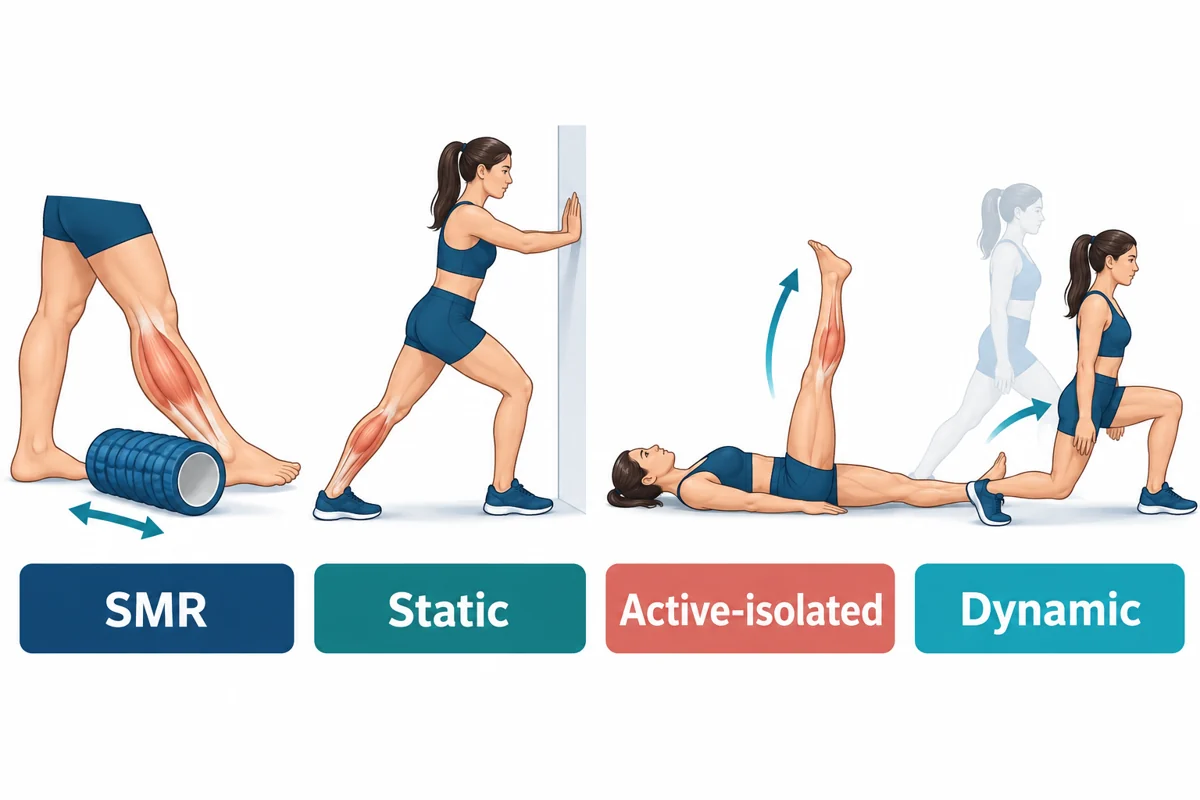
Flexibility questions become easier when you describe the action first. Is the person applying pressure with a roller, holding a position, moving a limb under muscular control for brief repetitions, or performing controlled movement through a task? Those descriptions help distinguish self-myofascial release, static stretching, active-isolated stretching, and dynamic stretching in NASM terminology.
A second question is why the technique was selected. The client may need work on an assessed restriction, preparation for a resistance session, or movement rehearsal before a performance task. The same body region can appear in several techniques. A calf exercise is not automatically a static stretch, and a movement does not become dynamic merely because the trainer calls it a warm-up.
Self-myofascial release
NASM places self-myofascial release, often abbreviated SMR, in its flexibility and corrective-exercise framework. A foam roller is one possible tool. In the corrective continuum, an appropriate pressure technique for a selected overactive target belongs to the inhibition step. The tool itself is not a diagnosis, and using a roller does not establish that every uncomfortable area needs the same intervention.
In a fictional learning case, a client uses a roller on a tissue identified through assessment, then follows with a relevant stretch. The first task and second task have different roles. Label the pressure technique separately from the lengthening technique. Do not describe rolling as isolated muscle strengthening or as proof that scar tissue has been broken apart. Those claims go beyond what is needed to identify the method.
Static stretching
Static stretching involves taking an appropriate position and holding it with controlled, tolerable tension. NASM's public flexibility material describes a thirty-second hold in its corrective-flexibility example. The key feature for identification is the maintained position rather than repeated movement. Pain is not the intended signal that the method is working.
Imagine a client holding a calf stretch without bouncing while maintaining a manageable position. That description points to static stretching. If the client is repeatedly moving in and out of the position, the action needs a different description. For an assessment question, first identify what actually occurs; then consider whether it matches the purpose and context in the case. Do not use one duration as a substitute for observing the action.
Active-isolated stretching
Active-isolated stretching uses muscular action to move a limb through the selected range with brief holds and repetitions. NASM discusses it within active flexibility. Its educational distinction from a longer static hold is the active movement and short repeated exposure. A person lifting a straight leg under control can illustrate the concept if the setup and target movement are appropriate.
The word active does not mean fast, forceful, or painful. It also does not mean that every ordinary resistance exercise is now a flexibility drill. In a study item, identify the movement purpose, how the limb is moved, and whether the position is briefly repeated or held. Those details carry more information than a generic phrase such as stretching the hamstrings, which could describe several different techniques.
Dynamic and functional flexibility
Dynamic stretching uses controlled movement through available range. NASM discusses functional flexibility in relation to dynamic movement that prepares the person for upcoming demands. Controlled lunges with reach can serve as a learning example. Movement quality, direction, and the relationship to the intended task matter more than making the sequence look athletic.
Dynamic does not mean ballistic bouncing at the limit of motion. A useful distinction is between a controlled movement that the client can organize and an uncontrolled push into range. When reviewing a case, ask whether the preparation resembles the movement demands that follow and whether it fits the person's current capacity. More complex movement is a different demand, rather than an automatic improvement over a simpler preparation task.
Match the method to the assessment
NASM connects flexibility choices with assessment findings and the wider training plan. Corrective flexibility is commonly described with SMR and static stretching. Active flexibility includes active-isolated work. Functional flexibility includes dynamic movement. These categories help organize learning, but individual exercise selection still needs a reason grounded in the person's findings and goals.
For example, a fictional client with an assessed restriction and a client preparing for a controlled multidirectional task may need different emphases. The exam skill is linking the method to the stated purpose. Do not assume that stretching every muscle is the answer to every movement observation. A suspected underactive target may require an activation decision, and a painful task requires stopping and appropriate referral rather than simply selecting a stronger stretch.
Avoid absolute claims about warm-ups
The effect of stretching depends on the technique, duration, person, and activity context. NASM's public discussion of static stretching reviews these distinctions. It does not justify a blanket claim that every static stretch before exercise is harmful or that any one flexibility method prevents all injuries. Be careful when a true statement about one situation is expanded into a rule about everyone.
For revision, make four cards with a plain description on one side and the NASM method on the other. Add a second line explaining the purpose in a fictional case. Then reverse the exercise: choose the description that would make each label incorrect. This forces you to notice held versus moving positions and pressure versus muscle activation. The three questions below test the corrective-continuum roles and a controlled static-stretch cue.
Put the concept into practice
Answer an original 30-question set for your chosen certification, then review your domain report.
Try 30 free questionsUSD 9.99 · Access detailsSee the current purchase availability and access terms on the product page.
Questions about this topic
Is dynamic stretching the same as bouncing?
No. Dynamic stretching uses controlled movement; the label does not justify uncontrolled bouncing at the end of range.
Where does a static stretch sit in the corrective continuum?
A static stretch for an appropriate shortened target belongs to the lengthen step.
Official sources
Checked 27 October 2026
- NASM seventh-edition textbook errata · 2026-10-27
- NASM textbook errata notice · 2026-10-27
- NASM Scientific Rationale for Stretching: integrated flexibility continuum · 2026-10-27
- NASM Scientific Rationale for Stretching · 2026-10-27
- NASM Stretches for Beginners · 2026-10-27
- NASM CPT7 exam blueprint · 2026-10-27
- NASM Corrective Exercise Continuum · 2026-10-27