NASM · Source check: 27 October 2026
NASM Nutrition Basics for CPT: Energy, Labels, and Scope
Review macronutrient energy calculations, serving-size comparisons, and the boundary between general nutrition education and clinical care.
NASM Essentials of Personal Fitness Training, 7th edition terminology; official public resources cross-checked 27 October 2026. Consult the official errata for corrections.
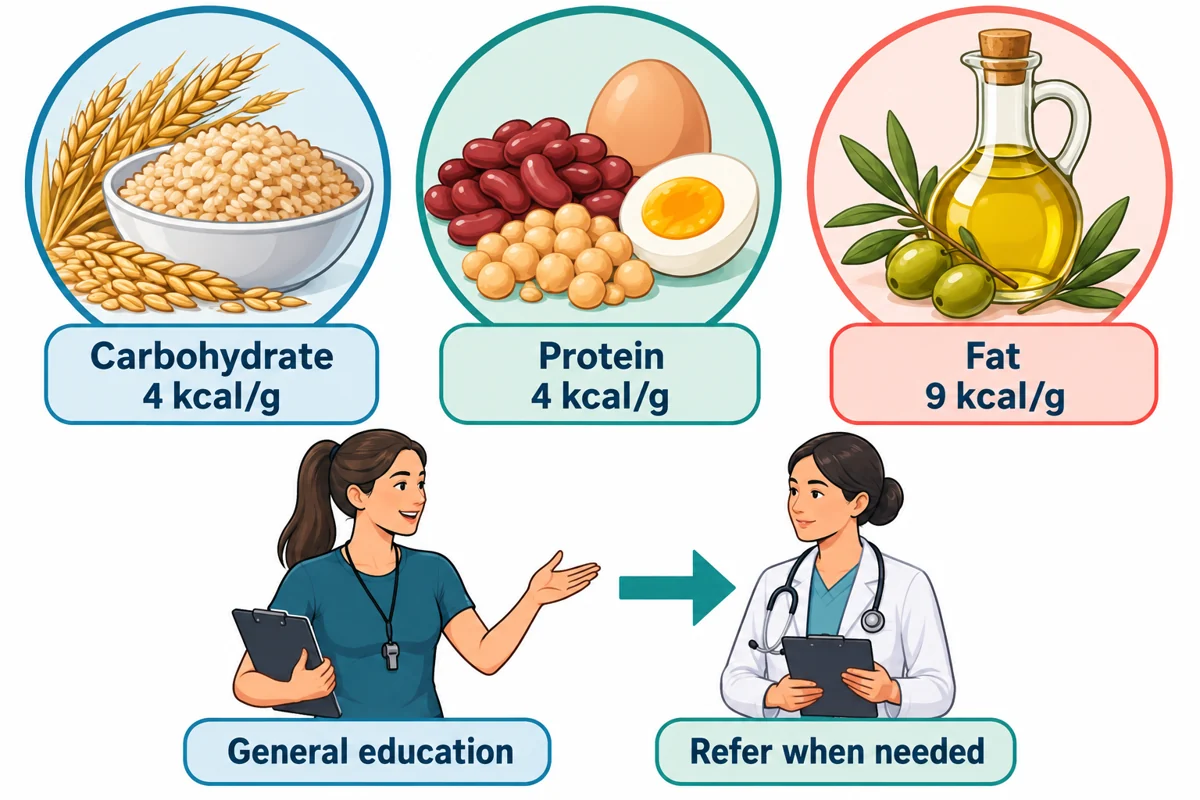
Learn the calculation and the professional boundary
For a CPT, nutrition study includes understanding basic concepts and knowing when a client's request exceeds the role. Explaining a food label is different from treating a disease with an individualized therapeutic diet. NASM's CPT curriculum describes general nutrition discussion while placing specific diet prescription outside the personal trainer's scope.
This guide focuses on the seventh-edition learning context and publicly supported fundamentals. It does not provide a meal plan or a medical nutrition prescription. In a question, identify both the task and the requested service. A calculation may be straightforward while the proposed next action is inappropriate. A correct energy total does not give a trainer authority to manage a client's kidney disease, eating disorder, or medication-related nutrition issue.
The 4, 4, and 9 factors
For basic energy-estimation questions, carbohydrate and protein are commonly assigned four kilocalories per gram, while fat is assigned nine. FDA's public nutrition-education material uses these factors. Keep the unit attached to the number: grams describe nutrient mass, while kilocalories describe energy. Adding grams of different nutrients does not directly produce an energy total.
Suppose a fictional snack has twenty grams of carbohydrate, ten grams of protein, and five grams of fat. The components are eighty, forty, and forty-five kilocalories. Their sum is one hundred sixty-five kilocalories. This example specifies only these three macronutrients. A question that includes alcohol, fiber adjustments, or sugar alcohols requires attention to the factors and assumptions supplied rather than blindly applying the simplified three-term calculation.
Use a repeatable calculation sequence
Write the three nutrient amounts on separate lines. Multiply each by its stated energy factor, then add the energy values. Round only as the question requests. This method makes the work auditable and helps locate a wrong answer. For instance, multiplying fat grams by four instead of nine can create a plausible-looking total that is still based on the wrong factor.
The sequence also helps you explain an answer rather than recognizing a familiar number. In a fictional item, changing only the fat amount changes the fat-energy term. Recalculate that term and retain the unchanged ones. Treat the result as an estimate under the stated assumptions, not as an exact laboratory measurement of the energy that a particular individual absorbs from that food.
Serving size changes the comparison
A label's nutrient values apply to the stated serving. Before comparing two foods, establish how much the client actually plans to eat. If one label describes half a package and another describes an entire package, comparing the printed numbers without adjusting the quantities answers a different question. This is an education problem about units before it is a judgment about food choice.
For practice, imagine a packet whose label reports values for one serving while the packet contains two servings. Eating the whole packet requires accounting for both servings. Then compare that planned amount with the planned amount of the second food. Keep the calculation separate from moral labels such as good food or bad food. The numbers describe the stated quantity and do not summarize the person's entire diet or goals.
Energy totals do not describe all nutritional value
An energy calculation answers an energy question. It does not by itself describe food variety, micronutrient intake, hydration, preferences, access, or the overall eating pattern. NASM's public coaching material includes these broader fundamentals and emphasizes communication and sustainable habits. A CPT should recognize the limits of what can be inferred from one number.
Consider two fictional snacks with the same calculated energy. Equal totals do not establish identical nutrient composition. One could contain more fat and another more carbohydrate under the same simplified calculation. If an answer choice claims that equal kilocalories prove the foods are interchangeable for every client and every purpose, it adds a conclusion the arithmetic did not establish. State exactly what the calculation supports, then stop there.
Education, coaching, and referral
General education can include discussing labels and public healthy-eating guidance. Coaching can help a client identify a realistic habit and the circumstances that make it difficult. Clinical nutrition assessment and treatment belong with appropriately qualified professionals. A personal training credential should not be treated as a substitute for those qualifications.
In a fictional consultation, a client wants help understanding serving sizes; a trainer can explain the label and check understanding. A different client asks for a diet to treat a diagnosed condition; the response needs an appropriate referral. Continue supporting agreed exercise and general habits within the professional role. Avoid prescribing a disease-specific restriction merely because a client prefers an immediate answer or because the trainer has personal experience with a similar diet.
Make the next step practical and client-centered
A useful conversation connects information to the client's circumstances. Ask what the client wants to understand, explain the relevant concept in plain language, and check that the client can apply it to the planned amount. A feasible habit chosen with the client is more useful than a rigid instruction that ignores access, preferences, or schedule. The aim is an informed next action within scope.
For revision, divide a page into calculation, interpretation, and action. Under calculation, show the factors and units. Under interpretation, state what the total does and does not establish. Under action, decide whether the request calls for general education, collaborative habit support, or referral. This keeps a nutrition item from becoming only mental arithmetic. The three questions below test a serving-size comparison and two energy calculations using the original bank's stated assumptions.
Put the concept into practice
Answer an original 30-question set for your chosen certification, then review your domain report.
Try 30 free questionsUSD 9.99 · Access detailsSee the current purchase availability and access terms on the product page.
Questions about this topic
Does a correct calorie calculation authorize a therapeutic meal plan?
No. Calculation skill does not change the personal trainer scope; clinical nutrition needs appropriate professional care.
Should label values be compared without serving-size adjustment?
No. Compare the quantity actually planned, using the serving information and the number of servings.
Official sources
Checked 27 October 2026
- NASM seventh-edition textbook errata · 2026-10-27
- NASM textbook errata notice · 2026-10-27
- NASM CPT curriculum · 2026-10-27
- FDA Science and Our Food Supply: nutrition label education · 2026-10-27
- NASM Nutrition Coaching Skills and Scope · 2026-10-27
- NASM How to Become a Certified Nutrition Coach · 2026-10-27
- FDA How to Understand and Use the Nutrition Facts Label · 2026-10-27