NSCA · Source check: 27 October 2026
NSCA Testing Order: Measure Skill and Power Before Fatigue
Organize a fitness assessment around the purpose of each test, resting measures, fatigue interference, recovery and repeatable conditions.
NSCA-CPT study scope: NSCA’s Essentials of Personal Training, 3rd edition, listed by NSCA as a CPT preparation resource. Additional public NSCA/publisher materials are identified by their own context; they are not presented as verbatim CPT textbook tables or an exact exam blueprint.
Choose the test before choosing its station
A test battery should answer a defined question about the client's current abilities. NSCA personal-training preparation includes consultation, assessment, and program planning, so test selection and interpretation belong together. The first decision is which measures are appropriate and useful. Only then should the trainer decide how to arrange the session, equipment, instructions, rest, and recording process.
For an illustrative client who wants to climb stairs more comfortably, an assessment should help guide that goal within the client's abilities and health information. Adding every test available in the gym can create fatigue without adding useful information. Write the purpose beside each proposed task. If two tests answer the same question, or one cannot be performed under suitable conditions, reconsider it. A shorter battery with interpretable measures can be more useful than a long sequence whose later scores mostly describe accumulated fatigue.
Protect resting information before exercise
Resting measurements need to be collected under the conditions specified for resting assessment. A pulse taken after a demanding step test is a post-exercise response, even if it is entered in a box labeled “resting.”
Imagine that a trainer has only one measurement station and wants to use it after all active tests. Saving equipment time is a practical concern, but it does not make the resulting number a baseline. Plan the resting assessment before exertion and document the preparation required by the protocol. If the client arrives rushed, clarify the circumstances instead of pretending the first available reading is standardized. In a case question, identify the measurement condition before choosing an answer about the client's fitness.
Put skill and explosive quality ahead of fatigue
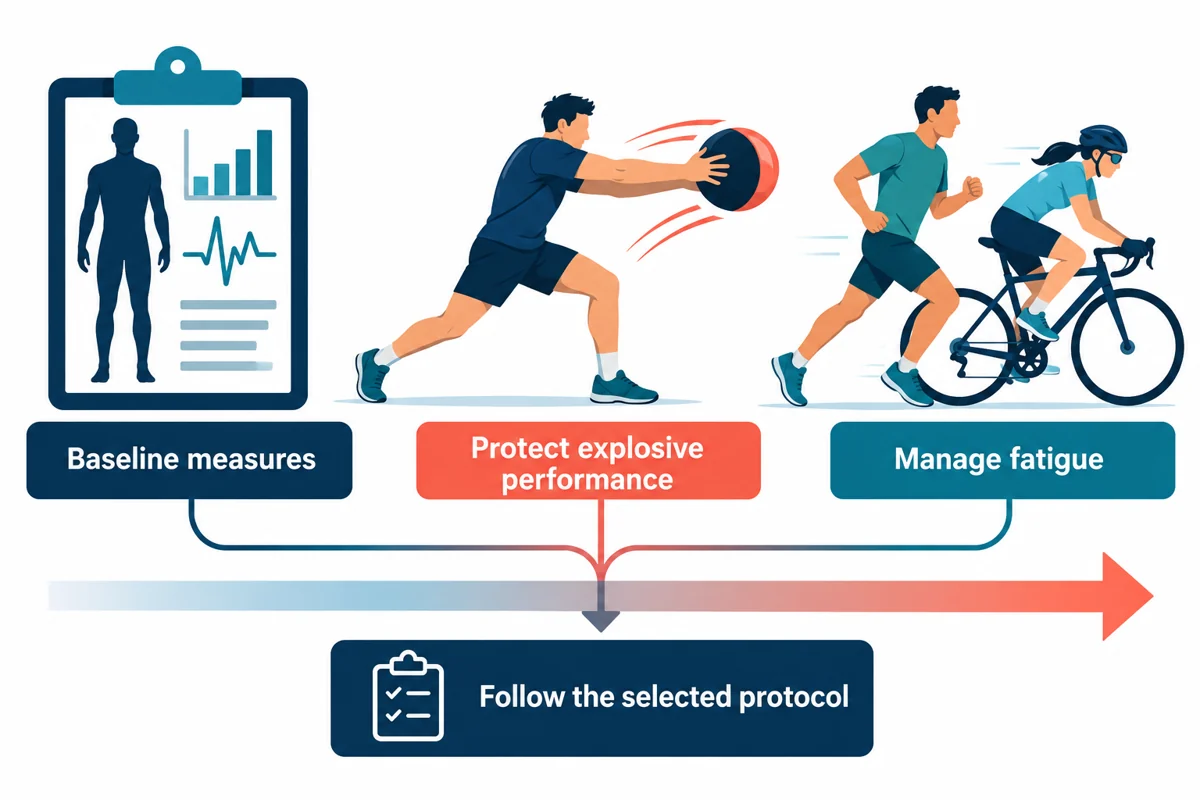
The authorized Human Kinetics assessment excerpt states that explosive or more complex tests should precede more fatiguing tests, because fatigue can impair the earlier type of performance. This is the main organizing principle illustrated here. It is not a claim that every personal-training battery has one universal order or that an athletic performance battery can be applied unchanged to every client.
Consider a session containing an appropriate jump assessment and a demanding repeated-effort task. If the goal is to measure fresh jumping performance, doing the repeated-effort task first changes that condition. The later jump score may reflect both jumping ability and prior fatigue. A useful answer explains the interference rather than simply saying “power first.” If a test requires skill, it also needs suitable instructions and preparation. Moving it earlier does not compensate for asking a client to perform a task they have not understood.
Distinguish different endurance demands
Local muscular endurance, repeated high-intensity effort, and aerobic capacity assessments ask different performance questions. They should not be treated as interchangeable just because each can be tiring. NSCA's personal-training preparation covers several dimensions of fitness and exercise science. Select and sequence the tests according to their protocols, the capacities being assessed, and how one task may interfere with another.
For a worked planning example, compare a controlled upper-body repetition test with a demanding whole-body endurance task. A trainer should ask what each score is intended to represent, whether the same muscles will be fatigued, and what recovery the protocols require. If the available time cannot support both measures well, a separate visit may be preferable to collecting a compromised second score. The diagram on this page presents a conceptual fatigue-management sequence; it should not be memorized as an exact replacement for a named battery's published instructions.
Rest and standardization make comparisons meaningful
The Human Kinetics excerpt also emphasizes similar environmental conditions, clear standardized instructions, appropriate preparation, recorded equipment, the same trial count, and consistent recovery between attempts and tests. These details help a later result answer the same question as the baseline. The order is one part of that standardization, not an isolated requirement.
Suppose the baseline uses three trials on a dry surface and the follow-up uses one trial on a slippery surface. A different score cannot be attributed to training alone. Or suppose one tester encourages every repetition while another gives no standardized cues. The test conditions have changed. Keep a record that another professional can reproduce: setup, units, instructions, trials, rest, order, and deviations. When a protocol must change for a valid reason, label the change and limit the comparison rather than hiding it to make the record look tidy.
Interpret the score within its limits
NSCA assessment and program-planning responsibilities connect the measurement with the next training decision. A score does not automatically diagnose a medical condition, and a small difference does not explain its own cause. Ask whether the test was appropriate, whether the protocol was followed, and whether the comparison is valid before treating the result as evidence that the program worked or failed.
Use a final review with four questions. What was measured? Under which conditions? What changed from the earlier assessment? What practical decision follows? If the client improves on the same relevant task with comparable conditions, that supports a different conclusion from an improved score after the test became easier. If fatigue or poor preparation undermined the session, the next step may be a better-controlled assessment. A well-run battery produces information that can be used, not simply a completed sheet of numbers.
Put the concept into practice
Answer an original 30-question set for your chosen certification, then review your domain report.
Try 30 free questionsUSD 9.99 · Access detailsSee the current purchase availability and access terms on the product page.
Questions about this topic
Why place explosive tests before fatiguing tests?
Prior fatigue can impair explosive or complex performance and make the result describe a different condition.
Is the diagram an exact official test-battery sequence?
No. It illustrates fatigue management. Follow the published protocol for the actual assessment battery and client.
Does keeping the same order guarantee a fair comparison?
No. Equipment, preparation, instructions, trials, recovery and environmental conditions also matter.
Official sources
Checked 27 October 2026