NSCA · Source check: 27 October 2026
NSCA Program Design Variables: Connect the Goal to the Session
Study needs analysis, exercise selection, order, frequency, load, volume and rest with worked programming decisions and clear calculations.
NSCA-CPT study scope: NSCA’s Essentials of Personal Training, 3rd edition, listed by NSCA as a CPT preparation resource. Additional public NSCA/publisher materials are identified by their own context; they are not presented as verbatim CPT textbook tables or an exact exam blueprint.
Begin with a needs analysis
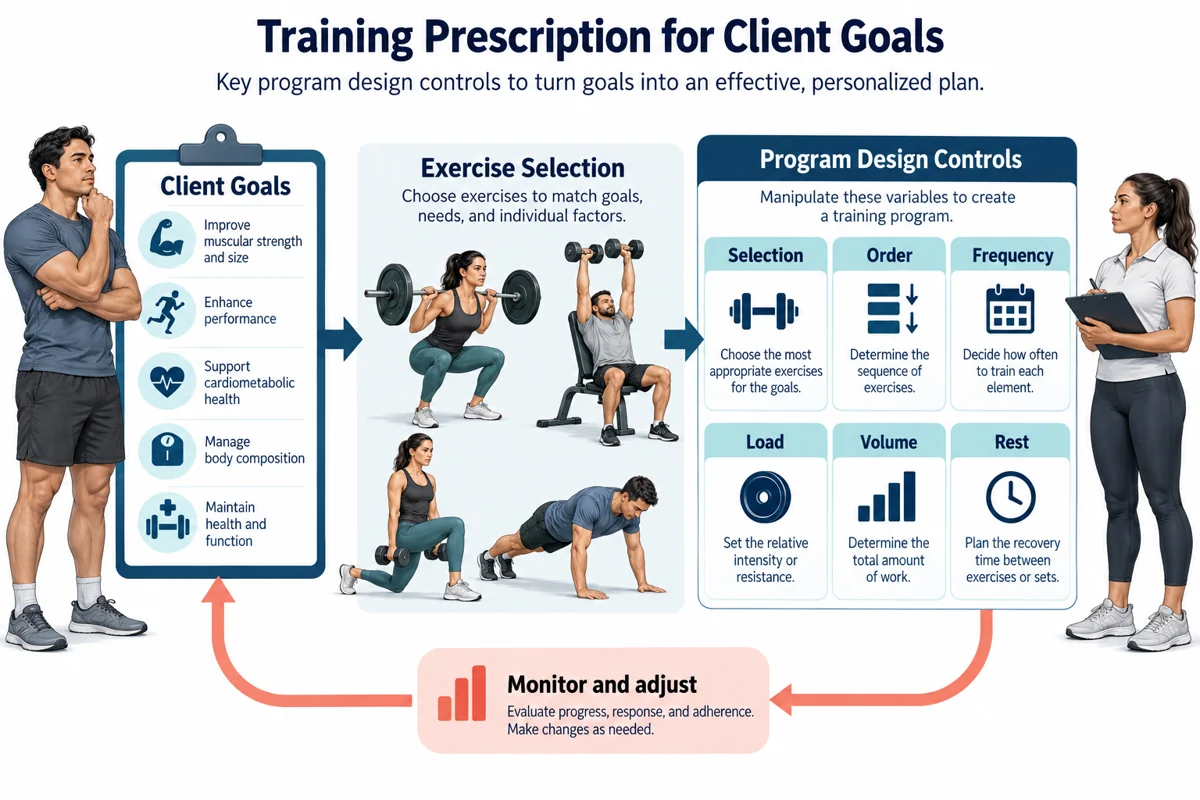
Program design starts with what the client needs and can currently do. The NSCA's public programming resources organize exercise planning around the client or athlete rather than a favorite set-and-repetition pattern. A needs analysis identifies goals, training experience, abilities, constraints, and relevant health information. That information gives the later choices a reason: exercise selection, frequency, order, load, repetitions, volume, and rest must work together.
Consider a client who wants to carry groceries upstairs and can train twice each week. The useful question is not whether a popular six-day split looks advanced. Ask which tasks matter, what baseline is appropriate, what equipment is available, and how the sessions can be completed. This example illustrates the reasoning process; it is not a universal prescription. If the program cannot be explained in relation to the client's goal and circumstances, changing the rep count alone will not fix it.
Select exercises for the intended demand
Exercise choice shapes the movement and tissues being challenged. NSCA material on specificity connects training decisions with the demands the person needs to improve. A program should therefore describe why an exercise is selected, whether the client can perform it, and what alternative is available if the equipment or setup is unsuitable. A name on a workout sheet does not establish that these conditions have been met.
For an illustrative carrying goal, compare a suitable carrying task with a machine exercise that trains only one part of the task. Either might have a role, but they answer different needs. A trainer could use a simpler exercise to build a missing capacity and a task-specific exercise to practice applying it. In a case question, identify the missing link before choosing another exercise. More variety is not automatically better if the added exercise has no clear purpose or cannot be coached.
Frequency and order organize the available work
Frequency is how often training occurs, while exercise order determines where each task appears within a session. NSCA educational standards identify both as program variables. A schedule has to account for training demands and recovery rather than simply filling every free day with the same session.
Imagine a novice who reliably has two training windows each week. An illustrative full-body organization may be easier to complete than dividing the week into body-part sessions that leave major tasks untrained when a visit is missed. Within a session, a technically demanding priority exercise should not be placed wherever a machine happens to be free without considering fatigue. Explain what the session is prioritizing, then arrange the other work around that priority. Convenience matters, but it should be made visible as a constraint.
Distinguish load, repetitions and volume
Load describes the resistance used; repetitions count completed actions; sets group those repetitions. Volume can be recorded in several ways, so state the measure. Volume-load is one calculation: multiply the repetitions performed at each load and sum them. A plan of three sets of eight repetitions with the same 20 kg load gives 480 kg of volume-load, assuming all planned repetitions are completed.
That number is useful bookkeeping, but it does not make two different exercises or clients physiologically identical. For a worked comparison, three sets of eight at 20 kg and two sets of twelve at 20 kg both total 24 repetitions and 480 kg. They have different set structures. If the question asks which variable changed, name the sets and repetitions rather than claiming that nothing changed because one summary value stayed equal. Also distinguish the prescribed work from the work actually completed.
Rest protects the quality the session needs
Rest intervals are part of a prescription. Their suitability depends on the goal, task, loading, training status, and quality that must be repeated. Cutting rest changes the session even if the exercise names, load and planned repetition count stay the same. It can also change whether the client can perform the intended work.
Suppose a technically competent client repeatedly completes a heavy set with the planned rest, then loses several repetitions when the rest is shortened. Before reducing the load or adding more exercises, identify the deliberate change. If preserving heavy-set performance remains the goal, restoring appropriate recovery is a direct option to evaluate. If the goal itself changes, the prescription may change too. Avoid treating a shorter rest interval as an automatic improvement; it must serve the task rather than make the workout merely feel busier.
Progress using a record you can interpret
Progression changes training demands over time. A useful log states the exercise, sets, repetitions, load, rest, and the observed response. Without those details, a claim that the client “did more” may hide a different exercise range, longer rest, or a changed task.
As an illustrative decision rule, a trainer might review a load increase only after the client meets the target repetitions with acceptable technique across the agreed sessions. The exact rule must fit the client and program; this example is not an official threshold. If performance falls, look at the pattern and context before adding work. A strong case answer identifies which variable is being changed, why that change addresses the problem, how the other variables will be managed, and what evidence will be checked next.
Put the concept into practice
Answer an original 30-question set for your chosen certification, then review your domain report.
Try 30 free questionsUSD 9.99 · Access detailsSee the current purchase availability and access terms on the product page.
Questions about this topic
Are sets and volume-load the same thing?
No. Sets describe grouping; volume-load sums repetitions multiplied by resistance. Always state how volume is being measured.
Does less rest always make a program better?
No. Recovery should support the intended goal and the quality of the work that must be repeated.
Should exercise choice precede understanding the client?
A needs analysis gives exercise selection and the other variables a purpose, using the client’s goals, abilities and constraints.
Official sources
Checked 27 October 2026
- NSCA Essentials of Personal Training, Third Edition: official publisher · 2026-10-27
- NSCA-CPT Third Edition official publisher course: public objectives · 2026-10-27
- NSCA-CPT Third Edition official publisher course: public objectives · 2026-10-27
- Specificity and the Tactical Athlete · 2026-10-27
- Program Design and Sample Training Approaches: official NSCA excerpt · 2026-10-27
- NSCA-CPT Third Edition official publisher course: public objectives · 2026-10-27
- Human Kinetics: Assessing Your Athlete · 2026-10-27