NSCA · Source check: 27 October 2026
NSCA Energy Systems: Match the Demand, Not Just the Stopwatch
Understand phosphagen, glycolytic and oxidative contributions, how they overlap, and what intensity, duration and recovery mean for training.
NSCA-CPT study scope: NSCA’s Essentials of Personal Training, 3rd edition, listed by NSCA as a CPT preparation resource. Additional public NSCA/publisher materials are identified by their own context; they are not presented as verbatim CPT textbook tables or an exact exam blueprint.
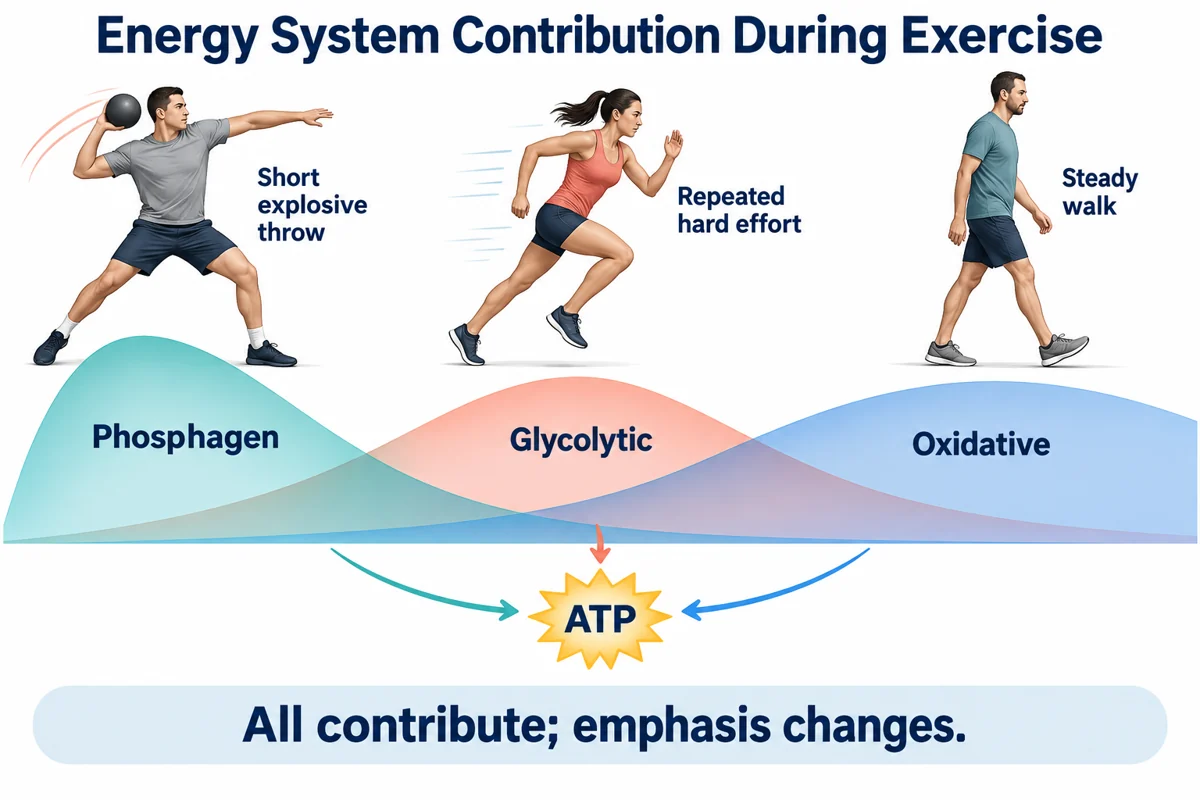
ATP supply is shared work
Muscle activity requires ATP, and the body uses several pathways to replenish it. NSCA's public energy-dynamics excerpt emphasizes that the phosphagen, glycolytic, and oxidative systems operate together during exercise. The contribution of each changes with the intensity and duration of the task. Calling an activity “aerobic” or “anaerobic” describes an emphasis; it does not mean the other systems switch off.
This distinction matters when reading a case. A long exercise session can contain a short explosive effort, while a repeated-sprint session also includes recovery periods. Do not classify every second of the session from its overall label. First identify the specific effort being discussed: its intensity, duration, repetition pattern, and recovery. Then explain the likely dominant contribution without claiming exclusive use of one system. That is more accurate than treating three energy systems as three separate tanks opened in a fixed sequence.
Phosphagen: rapid ATP support for brief intense work
The phosphagen system uses stored phosphagens, including phosphocreatine, to support rapid ATP replenishment. It can supply energy quickly but has limited capacity compared with pathways that sustain longer exercise. The Human Kinetics energy-systems excerpt distinguishes this rapid, short-duration contribution from glycolytic and oxidative production. It is commonly relevant when thinking about a brief explosive movement.
Consider an illustrative single jump or a short heavy effort. The task asks for rapid force rather than sustained output over many minutes. That makes the phosphagen contribution a useful part of the explanation. Now extend the task into many repeated efforts with short recovery. The initial description is no longer enough: repetition and recovery change the demand. Avoid making a rigid claim that a particular second marks the instant this system ends. The important study concept is its rapid supply and limited capacity within an overlapping system.
Glycolytic: carbohydrate supports demanding work
Glycolysis breaks down carbohydrate to contribute ATP. It can make an important contribution when high-intensity activity continues beyond a very brief effort or is repeated with limited recovery. The public publisher excerpt describes glycolytic work alongside the phosphagen and oxidative pathways. The word anaerobic refers to the pathway's immediate oxygen requirement; it does not mean the person has stopped taking in oxygen.
For a worked comparison, imagine an all-out brief acceleration and a longer hard effort. They may both feel intense, but the second requires ATP to be supplied for longer. Now compare that effort with a comfortable continuous activity. The combination of intensity and duration has changed again. A case answer should explain those changes rather than choose glycolysis whenever the client says “burning” or “tired.” Sensations alone do not provide a complete analysis of energy contribution, and the training goal still needs to be specified.
Oxidative: sustained supply and recovery context
The oxidative system uses oxygen in ATP production and can use carbohydrate and fat, with other substrates contributing under some conditions. The authorized publisher excerpt contrasts this aerobic pathway with the phosphagen and glycolytic systems. It is important during sustained activity, but it also operates while brief high-intensity work is being performed. NSCA's energy-dynamics discussion makes that overlap explicit.
Picture a client moving steadily at a manageable effort, then briefly climbing a steep section before returning to the earlier pace. The task has not changed from one isolated system to another; the balance of contribution shifts. When explaining the case, identify which portion is being discussed and what changed. The steady section supports a different dominant contribution from the brief harder section. A correct explanation can acknowledge that distinction while still recognizing that oxidative metabolism continues to participate throughout the session.
Recovery changes the next effort
Work and recovery belong in the same analysis. A program that repeats brief efforts with long recovery has a different purpose and demand from one that compresses the same efforts into short intervals. NSCA's programming materials include rest periods among the variables that influence the session. The energy-system label alone does not specify how many repetitions to perform or how much recovery a particular client needs.
Use an arithmetic example: a hypothetical 10-second effort followed by 30 seconds of rest has a work-to-rest ratio of 1:3. A 10-second effort followed by 60 seconds has a ratio of 1:6. These calculations describe the schedule; they are not recommendations for a particular energy system. To evaluate a real prescription, ask what output must be preserved, how the client responds, and whether the intended quality is maintained. Do not infer complete physiological recovery simply because the arithmetic ratio has been calculated correctly.
Use the concept to read program choices
NSCA program design connects the client's goal with the task and its training demands. Energy-system reasoning contributes to that decision, but it does not replace screening, movement skill, appropriate loading, or recovery planning. A beginner's entry session and an experienced client's repeated high-output session may have different purposes even when both use the same exercise machine.
To study effectively, describe an effort without using an energy-system name. State how hard it is, how long it lasts, how often it is repeated, and how much recovery occurs. Then add the likely dominant contribution and explain your reasoning. Change one feature and reassess the explanation. If you can only answer when a table gives an exact time boundary, revisit the overlap principle. Good reasoning recognizes the difference between an educational classification, the prescription written on paper, and the work the individual actually completes.
Put the concept into practice
Answer an original 30-question set for your chosen certification, then review your domain report.
Try 30 free questionsUSD 9.99 · Access detailsSee the current purchase availability and access terms on the product page.
Questions about this topic
Does one energy system switch off when another becomes dominant?
No. All three operate together; their relative contributions change with the task.
Does anaerobic mean the person is not breathing?
No. It describes a pathway’s oxygen requirement, not whether the person breathes during the activity.
Does a 1:3 work-to-rest ratio automatically define the energy system?
No. A ratio describes timing. Intensity, duration, repetition pattern, purpose and individual response also matter.
Official sources
Checked 27 October 2026
- NSCA Essentials of Personal Training, Third Edition: official publisher · 2026-10-27
- Energy Dynamics During Exercise: official NSCA excerpt · 2026-10-27
- Energy Systems: Human Kinetics authorized excerpt · 2026-10-27
- NSCA-CPT Third Edition official publisher course: public objectives · 2026-10-27
- Program Design and Sample Training Approaches: official NSCA excerpt · 2026-10-27
- NSCA-CPT Third Edition official publisher course: public objectives · 2026-10-27