NSCA · Source check: 27 October 2026
NSCA Periodization: Plan Changes Without Losing the Goal
Learn the difference between periodization and daily programming, linear and undulating patterns, recovery and practical review decisions.
NSCA-CPT study scope: NSCA’s Essentials of Personal Training, 3rd edition, listed by NSCA as a CPT preparation resource. Additional public NSCA/publisher materials are identified by their own context; they are not presented as verbatim CPT textbook tables or an exact exam blueprint.
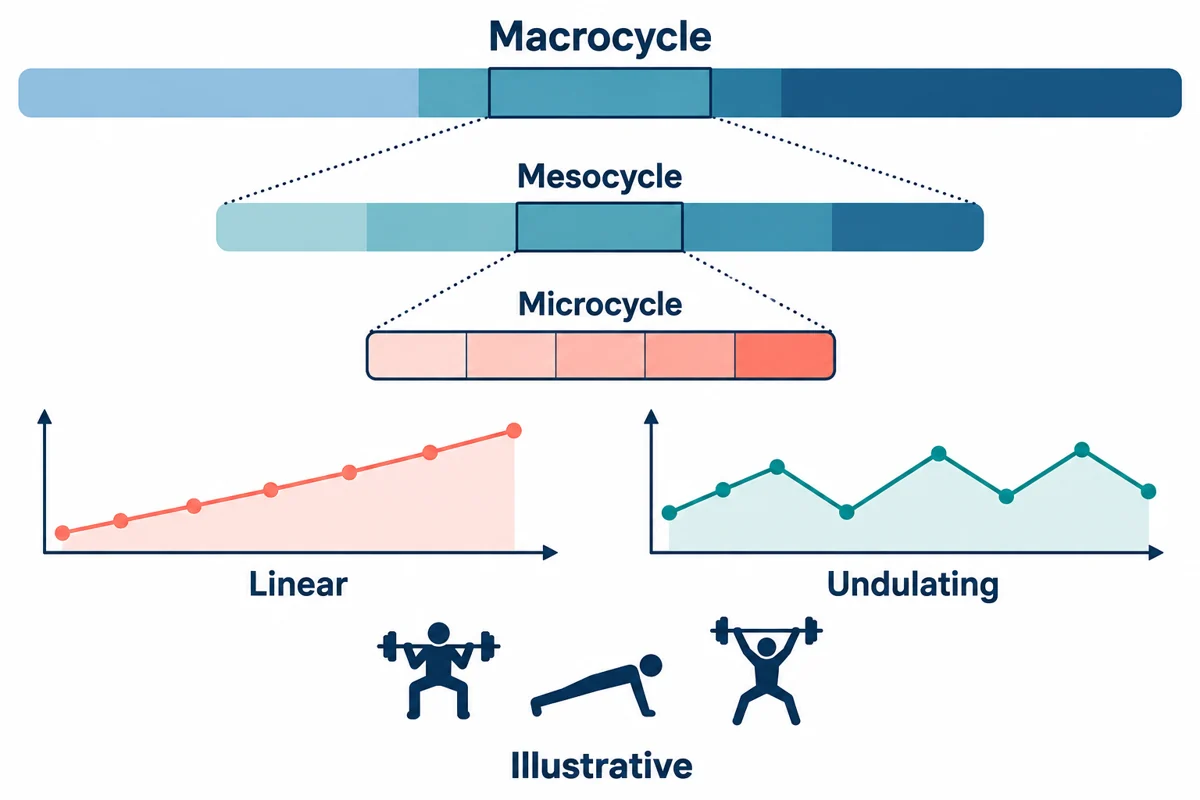
Periodization gives changes a purpose
Periodization organizes training over time so changes in the program serve a longer goal. Programming describes the actual work: exercises, load, repetitions, sets, rest, and schedule. NSCA educational material places planned variation, rest and recovery, and evidence-driven adjustment within the larger planning process. A calendar filled with different workouts is not enough; the changes need a reason and a relationship to what the client is trying to achieve.
Imagine a client preparing for a physically demanding trip several months away. The plan might first establish consistent training and basic capacity, then increase the emphasis on relevant demands. That example describes an organizing idea, not a required phase sequence. To evaluate it, ask what the current period is meant to accomplish, what evidence will show readiness for the next period, and how the program responds if the client misses sessions or recovers poorly.
Keep the planning levels distinct
Periodized plans can be viewed at several scales, from a longer overall cycle to shorter blocks, weeks, and individual sessions. Terms such as macrocycle, mesocycle, and microcycle identify those levels. NSCA's team-sport supplement describes different microcycle purposes and shows that the schedule reflects the setting. The exact calendar length should not be assumed to be identical for every client or training problem.
For an illustrative personal-training plan, label the long goal first, then the focus of the current block, then the coming week's sessions. A change to Tuesday's exercise order is a session-level change; it does not by itself explain the strategy for several months. Conversely, a statement such as “improve strength this season” leaves the daily dose unspecified. Keep both views available. The large plan explains where the work is heading, and the session record shows what was actually performed.
Recognize a linear pattern
An authorized Human Kinetics excerpt presents linear periodization as a pattern that moves from higher volume and lower loading intensity toward lower volume and higher loading intensity over the training cycle. The pattern describes how emphasis changes; it does not mean every exercise must increase in load at every visit or that every client needs the same number of weeks in each phase.
Use a simple recognition exercise rather than copying a template. Suppose one block uses more repetitions with lighter loads, and later blocks deliberately emphasize fewer repetitions with heavier loads. That description fits the general linear direction. Now ask what stays consistent: the client's goal, appropriate exercise technique, and the need to account for recovery. A question may offer a program in which all demands rise without a planned relationship. Do not call that linear periodization merely because the weights become heavier.
Recognize an undulating pattern
Undulating periodization varies volume and loading intensity more frequently instead of maintaining the same direction through each block.
For a fictional client, one session could emphasize a lower-repetition strength task while another emphasizes a different repetition target at a lighter load. The meaningful point is planned variation in the training emphasis, not random replacement of exercises. To read a case, compare the sessions within the week and the weeks within the block. If an answer identifies undulation, it should be able to say what varies, how often it varies, and why that variation fits the larger objective.
Recovery is part of the plan
NSCA material includes planned rest and recovery among the functions of periodized planning. These sources support including reduced-demand periods when appropriate; they do not establish a mandatory deload week for every client on the same calendar.
Consider a trained client whose performance has fallen across several sessions while fatigue remains high. Review training, recovery and health information before deciding the next action. A temporary reduction in training demand may be a reasonable program change when the situation fits, but the trainer should not use the word “deload” to dismiss new medical symptoms. In an exam case, identify whether the question is about accumulated training fatigue, a new symptom, a lack of adherence, or a poorly matched goal. Those descriptions can require different responses.
Review the plan without making it random
NSCA resources connect program design with tracking outcomes and adjusting the work to the client's demands. A periodized plan should be clear enough to review but flexible enough to respond to changed information. A missed week, a new restriction, or an event date change can alter the next step. Continuing the old schedule simply because it was printed does not demonstrate sound planning.
Use a short comparison at each review: intended focus, completed work, observed response, and next decision. If the planned strength work was not completed because the available sessions were too long, the first correction may be a more usable schedule. If the work was completed with good tolerance, progression may fit. If an important event is near, review fatigue and readiness rather than adding last-minute workload without a purpose. The central study skill is explaining how a short-term change remains connected to the longer goal.
Put the concept into practice
Answer an original 30-question set for your chosen certification, then review your domain report.
Try 30 free questionsUSD 9.99 · Access detailsSee the current purchase availability and access terms on the product page.
Questions about this topic
Is periodization the same as changing exercises randomly?
No. The changes are planned in relation to a longer goal, with workload and recovery organized over time.
What distinguishes linear and undulating patterns?
Linear patterns generally shift from higher volume and lower loading intensity toward lower volume and higher loading intensity; undulating patterns vary those demands more frequently.
Must every client deload on a fixed weekly schedule?
The cited public sources do not set one universal schedule. Recovery periods should reflect the program, client and response.
Official sources
Checked 27 October 2026
- NSCA Essentials of Personal Training, Third Edition: official publisher · 2026-10-27
- Periodization: NSCA educational presentation · 2026-10-27
- Periodization and Programming for Team Sports: supplement · 2026-10-27
- Periodisation: Human Kinetics authorized excerpt · 2026-10-27
- Specificity and the Tactical Athlete · 2026-10-27
- Program Design and Sample Training Approaches: official NSCA excerpt · 2026-10-27
- NSCA-CPT Third Edition official publisher course: public objectives · 2026-10-27