NSCA · Source check: 27 October 2026
NSCA Plyometric Progressions: Landing Quality Before More Demand
Study the stretch-shortening cycle, landing preparation, intensity, contacts, recovery and technique-based progression with clear client examples.
NSCA-CPT study scope: NSCA’s Essentials of Personal Training, 3rd edition, listed by NSCA as a CPT preparation resource. Additional public NSCA/publisher materials are identified by their own context; they are not presented as verbatim CPT textbook tables or an exact exam blueprint.
Know what the exercise is asking for
Plyometric exercise uses a rapid transition from an eccentric loading action toward a concentric action, often discussed as the stretch-shortening cycle. The NSCA's public excerpt explains this coupling and the substantial forces that can be involved. That purpose separates a power-oriented jump task from simply doing many repetitions until the client feels tired. Before progressing a drill, identify what movement quality the drill is intended to develop.
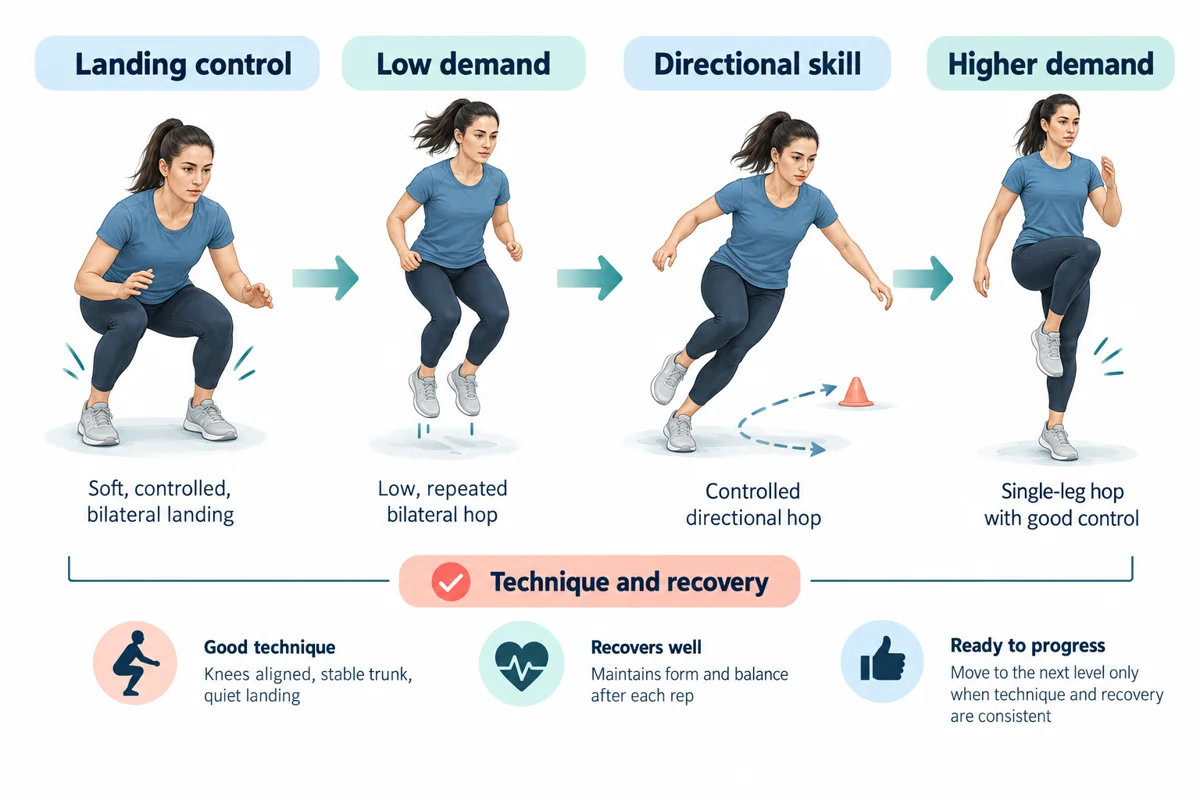
For an illustrative comparison, a controlled landing drill gives the trainer a chance to observe deceleration and position, while a quick rebound task adds a different demand. Both may appear in a progression, but they are not interchangeable measurements of the same task. State whether the priority is controlling the landing, producing an explosive takeoff, or linking contacts rapidly. A progression cannot be judged well if the goal changes without being acknowledged.
Build a landing the client can control
NSCA’s public plyometric guidance emphasizes technique and the ability to accept a landing with control. This is a reason to observe more than jump height. The trainer needs to see how the client accepts the landing and whether the task can be repeated with the intended quality. A successful takeoff does not by itself demonstrate readiness for a more demanding drill.
Imagine a client who leaves the ground easily but lands with poor control and cannot settle into the required position. Raising the target or adding more jumps does not address the observed problem. A suitable teaching response may reduce the demand and rehearse an appropriate landing before restoring the harder task. Record what changed: height, distance, speed, support, direction, or complexity. That record gives the next progression a basis beyond saying that the client “looked athletic.”
Intensity is not only the height of a box
Plyometric demand can change when the task changes its landing, support, velocity, direction, external loading, or complexity. NSCA's high-school soccer article discusses progression from bilateral to unilateral tasks and changes in height, while emphasizing technique. Its examples belong to that youth-sport setting; they should not be copied as a universal dose or progression for every personal-training client.
For a fictional progression, compare a low two-leg jump with a task that adds a single-leg landing. Even without a higher target, the movement demand has changed. Or keep the landing support the same but add a rapid rebound. The trainer should be able to say which demand was increased and what evidence showed readiness. Increasing height, speed, direction change, and repetitions at the same time makes the response harder to interpret and may remove the control the earlier drill was intended to establish.
Count volume without losing the quality
Lower-body plyometric volume is often described using foot contacts. The counting convention and exercise must be clear so the record means the same thing across sessions. NSCA's soccer article discusses contacts and states that high-intensity work should begin with low volume so the athlete can preserve execution quality and movement speed. The article's numerical examples are population-specific, so this guide does not turn them into a universal contact target.
Suppose two plans list the same number of contacts, but one uses low jumps in place and the other uses demanding drop-and-rebound tasks. The total count does not make the sessions equivalent. Record both the amount and the nature of the drill. If technique deteriorates before the planned count is reached, completing the number is not the only objective. The useful decision is whether to stop, rest, regress, or change the task to preserve its purpose.
Use strength and recovery in context
Select the task around the person's experience, control, health information, and the competence of the person teaching it.
Recovery also needs to support the intended work. If the session goal is explosive quality, a long fatigued series can become a different task from the one prescribed. An illustrative set should finish while the agreed quality is maintained, with recovery sufficient for the next appropriate effort. Avoid promising that one strength number proves readiness for every jump, or that a client must train to exhaustion for the drill to be useful. Read the task and the observed response together.
Progress and regress with a visible reason
NSCA conference resources describe plyometric progressions with options to regress, build confidence, and use clear coaching cues. The practical implication is that progression is a decision based on the movement and the client, rather than a reward for reaching the next date on a calendar. A trainer should know both the next challenge and an appropriate simpler option before teaching the session.
For a worked review, note the planned drill, the quality criterion, the completed amount, and any change. If a client performs the current drill consistently with control and appropriate tolerance, a carefully chosen increase may fit. If control deteriorates or the client becomes fearful, simplify and reassess. Pain or a new health concern requires an appropriate response rather than automatic repetition. In study questions, explain what was observed, which demand should change, and why that change addresses the observation before choosing a harder drill.
Put the concept into practice
Answer an original 30-question set for your chosen certification, then review your domain report.
Try 30 free questionsUSD 9.99 · Access detailsSee the current purchase availability and access terms on the product page.
Questions about this topic
Does the same contact count mean the same plyometric dose?
No. Exercise intensity, support, speed, complexity and landing demands also matter.
What should happen if landing control is lost on a low drill?
Reduce the demand, teach and reassess the landing, and use an appropriate simpler task before adding difficulty.
Official sources
Checked 27 October 2026
- NSCA Essentials of Personal Training, Third Edition: official publisher · 2026-10-27
- Stretch-Shortening Cycle: official NSCA excerpt · 2026-10-27
- Integrating Plyometric Training for High School Soccer Athletes, Part 2 · 2026-10-27
- Progressive Speed and Power Training Concepts · 2026-10-27
- Building Confidence Through Plyometric Progressions · 2026-10-27
- NSCA Certification Handbook · 2026-10-27
- NSCA: Plyometric Exercises · 2026-10-27